Gelli Fach

Gelli Fach

I'm a cell, I'm fragmented, I change my form;
I'm a repository of song, I'm a dynamic state.
I love a wooded slope and a snug shelter,
and a creative poet who doesn't buy his advancement.

Wyf kell, wyf dellt, wyf datweirllet;
wyf llogell kerd, wyf lle ynnyet.
Karaf-y gorwyd a goreil clyt,
a bard a bryt ny pryn y ret.


From: Legendary Poems from the Book of Taliesin, edited and translated by Marged Haycock


Monday, 9 July 2012

The Olympic Flame and Semiotics


I’m rather behind with my posts after a difficult few weeks – so the event of the Olympic flame being carried through a neighbouring village actually happened a few weeks ago…

I hadn’t been overly fussed about it – not being a sporty person, even from an armchair – but when the route of the flame was shown on tv and a friend was quite excited because it was going to pass right by her house I began to think that it was quite a momentous occasion and asked if I could go and watch it with her.

It turned out to be one of those rare days – bright and sunny – which made it easier to get up, get dressed and have breakfast in time to arrive at her house uncharacteristically early for me, 8 am. There was a convenient bench by the side of the road near the house and so we went to sit on it and chatted with neighbours as we waited for the show to begin.

The razzmatazz started – rather bizarrely – with the police. Three of them roared up on huge motorbikes, blue lights flashing and positioned themselves across the road. Then came a Coca Cola bus and a Lloyds Bank bus full of smiling young people - it seemed churlish to entertain thoughts of how inappropriate it is for Coca Cola to be promoting a sports event or to consider  the disaster that is Lloyd’s Bank so I suspended my cynicism and waved with the rest. (At least the Coca Cola bus had cleaned up its emissions I was glad to see.)

While waiting for the torch-carrier to appear I chatted to one of my friend’s neighbours who informed me that he was a semiotician. “What’s that?” I asked. “That’s what most people say”, he replied, “It’s the study of signs”.  I thought that sounded interesting and rattled on to him about how I’d been thinking lately about how metaphor is endemic in language; how almost everything is described in terms of something else (although often we are not aware of it), meaning that thought reflects the interrelationship of things. “Ah yes”, he replied, "Roland Barthes said 'no sooner is a form seen than it must resemble something: humanity seems doomed to analogy'", adding that he himself thought it was a positive thing rather than a doom. Nietzsche also had something to say about this, I learnt, for instance: “The drive toward the formation of metaphors is the fundamental human drive, which one cannot for a single instant dispense with in thought, for one would thereby dispense with man himself”.

At this point the conversation was interrupted by shouts hailing the first glimpse of the torch-bearer, flanked by assistants.


The handover of the flame happened just beside us, where the next runner was waiting, leaving her predecessor recovering from the exertion and the emotion of the event. 


After all the excitement, my friend invited her neighbours and myself back for early elevenses and we sat in the garden in the heat of the morning with coffee and biscuits, chatting and joking. I’d have liked to have learnt more about semiotics but didn’t want to hijack the conversation by being nerdy :-)

Later, back home, I did a bit of research, finding an online introduction to the subject by my erstwhile informant, Daniel Chandler, Semiotics for Beginners. I haven’t read the whole book and have only a superficial grasp of the subject, but what I did understand appealed to me:

Humans might be described as meaning-makers - Homo significans; we are driven by a desire to make meaning which we do through our creation and interpretation of signs. Signs can be words, images, sounds, odours, flavours, acts or objects which only have meaning when we invest them with it.
Semiotics isn’t a discipline but a mode of inquiry. It’s important because it helps us to see that reality is in fact a system of signs and doesn’t have an independent, objective existence.


“Studying semiotics can assist us to become more aware of reality as a construction and of the roles played by ourselves and others in constructing it. It can help us to realize that information or meaning is not 'contained' in the world or in books, computers or audio-visual media. Meaning is not 'transmitted' to us - we actively create it according to a complex interplay of codes or conventions of which we are normally unaware. Becoming aware of such codes is both inherently fascinating and intellectually empowering.”  Deconstructing and contesting the realities of signs can reveal whose realities are privileged and whose are suppressed. The study of signs is the study of the construction and maintenance of reality. To decline such a study is to leave to others the control of the world of meanings which we inhabit.”


The chapter on Rhetorical Tropes I found the most interesting since poets have to choose, as Coleridge stated, not only words in the right order, but the right words in the right order. A poem is often quite short (compared to a novel for instance) and therefore has to signal its meaning in fewer words. The words are potentised in order to have the most impact and this potentisation is often achieved by metaphor – by signs - indeed, the whole poem may be a metaphor. The interpretation of these signs, the decoding, depends on the reader who gives meaning to the text. What this meaning will be depends to some extent on whether he or she is part of the culture the text has come out of and understands its conventions.
Inevitably, some signs will have individual significance for the reader – or indeed for the poet. It’s interesting in the poetry reading group I go to, how one person’s reading of a poem might be very different to another’s - or there again, skewed slightly - by an individual association of an experience with a particular object or sign.

Umberto Eco, I learnt, uses the term ‘semiosis’ to mean the process involved in a culture producing signs and attributing meaning to them. Although a social endeavour, he has recognised that an individual may use semiosis and that subjectivity will play a part in this. I recognise this in my own poetry where an object or act or experience will have a particular significance, potent to myself, but may be too personal to communicate that significance to the reader. (Poetry workshops are particularly useful, I find, in testing out whether or not a metaphor is too personal to contribute meaningfully to a poem.) But some of the best poetry works by extending the agreed meaning given to a particular sign in a highly-individual or personal way which is yet  comprehensible to the reader. Sometimes this meaning is almost out of our range and yet potent and evocative, stretching us, expanding our understanding in a thoroughly satisfying way.

I’m not sure now that I’m doing anything more in my musing than turning the same soil with a different tool, so I’ll stop :-)

To go back to my original recognition that metaphor is embedded in language and that we think about things and give meaning to things by associating them with other things… my feeling is that this connects us to everything – we are not separate and we cannot think separately. We know, at the level of thought, that we are part of everything else. Daniel Chandler says in his book  “tropes [figures of speech] can be seen as offering us a variety of ways of saying 'this is (or is like) that'". The Sanskrit Chandogya Upanishad goes further, saying, Tat Tvan Asi, ‘That thou art’ or ‘Thou art that’ –  the Self is identical with Ultimate Reality, the ground and origin of all phenomena, ‘the ten thousand things’.

As for the Olympic Flame – what a wealth of meaning and cultural associations! Reminiscent of Prometheus’ theft of fire from the god Zeus to give to humans, it was kept burning during the ancient Olympic games in Olympia, Greece. Our contemporary ceremony with the relay of the flame from Greece to the site of the current games was instigated in 1936 by the Nazis… the perpetrators of one of humanity's darkest hours. The flame is kindled in Olympia by the rays of the sun (through a parabolic mirror) – a ‘pure’ form of fire reminding us, perhaps, of the Olympian god, Apollo, a beardless, athletic youth associated with the sun. It celebrates the living flame, passed from generation to generation, as we once again display the physical prowess and fortitude of the human animal.

Put like that, it does feel quite momentous that it passed through the village of Bow Street and was handed over opposite the local Spa shop – a meeting of the global and the local, the mundane and the mythical, the past and the present. And how interesting to meet the neighbours!


Tuesday, 29 May 2012

Poetry at Strata Florida


 The church next to Strata Florida Abbey.
Dafydd ap Gwilym's yew tree is to the left of the picture.

Recently I went to the Open Day of the Centre for Advanced Celtic Studies at Strata Florida, or Ystrad Fflur,  the site of a Cistercian abbey. Although the weather was cold and grey, it was a truly lovely and inspiring day. Just what I needed as I had been decidedly lacking in hwyl (enthusiasm, humour) lately.
The abbey is about a mile from the village of Pontrhydfendigaid, Ceredigion, some 15 miles from where I live. Originally founded in 1164, many important manuscripts are thought to have been written there, namely Brut y Tywysogion, The Chronicle of the Princes, a major source for early Welsh history;  Llyfr Gwyn Rhydderch, The White Book of Rhydderch, which contains the stories of the Mabinogi, and the Hendregadredd Manuscript which contains an anthology of poems of the 12th and 13th century Beirdd y Tywysogion (the Poets of the Princes) or Y Gogynfeirdd (the Not So Early Poets). Around 1330 a number of poems by contemporary poets were added and there is one poem of Dafydd ap Gwilym’s which is probably written in his own hand.
Dafydd ap Gwilym was born not far away in the village of Penrhyncoch and it is likely that he was educated at Strata Florida by the monks and was buried in the churchyard there when he died. A fellow-poet, Gruffydd Gryg, wrote an elegy to him, addressing the yew tree which grew over his grave. It was the custom then, however, for poets to write elegies to each other when they were still alive so it isn’t certain that he is buried there. However it is thought that the yew is old enough to have existed in his time and there is a memorial to him placed there.


Yr ywen i oreuwas
Ger mur Ystrad Fflur a’i phlas;
Da Duw wrthyd, gwynfyd gwŷdd,
Dy dyfu yn dŷ Dafydd.

This yew-tree for the best of men,
Near the walls of Strata Florida and its hall;
God’s blessing on you, happy tree,
For growing as a house for Dafydd.

G
ruffydd Grug

In an earlier exchange of funeral odes with Dafydd, Gruffydd had written:

Tristach weithian bob cantref,
bellach naw digrifach nef.

Sadder now is every area of land,
but heaven is nine times more joyful.

Dafydd Johnston gave a talk among the ruins about the poets of the abbey, quoting from the medieval poet Dafydd Nanmor’s poem about Strata Florida. He tells how the Abbot  Rhys ‘cut ten complete windows, half the cost of this went in glass’; the abbey had roofs of 'heavy lead', 'so woven as to leave no holes for ice, water, snow or rain'. Between her walls were 'acres for burying lords' and there was music too – he heard the fair sounds of treble, mean (the refrain or chorus of a song) and burden there.  He related how there was a great belfry, lime dressed, huge and white, with a cock on top of it. It was so large that if Noah’s flood were to come again, all the saints inside would be protected.


The talk filled the empty spaces of the abbey with the words of the poets and thoughts and images of how magnificent it had been once…
No sun
but the stones
shine with history


After this it was time to go and learn about cynghanedd from Eurig Salisbury who perched on top of the wall by the garden. It had a rather medieval feel to it – being taught something in the open air, the words blown on the cold wind. Not so much a hedge school as a wall school perhaps… It was a very clear and concise introduction to complicated Welsh metres with an excellent handout. I was motivated the next day to try a few lines of (rather clumsy) cynhanedd sain to give an image of the day:


Sitting in the cold in the fold of Strata Florida
hearing the tale of the travail of the venerable
I catch sight of the flight of the falcon
which soars in the sky like the sigh of a soul
Ideally the lines should have 7 syllables (such as in 'Make fish the dish of the day' - remember that ad?) although I think more are permitted.
And then back to the impressive West Gate to hear poems about Strata Florida by the Welsh poet, Gwyneth Lewis. CADW commissioned her to write them in recognition of its literary and cultural associations and to celebrate the re-opening of the abbey. The poet said that this was for her the high point of her career and she planned later to light a candle at Dafydd ap Gwilym’s memorial ‘in gratitude and humility’.


The English poem had, at times, a bare, somewhat staccato feel to it, and it wasn’t until I saw it written down that I felt I understood the concept underlying it (although who knows whether it is what the poet intended). To me it seemed to contain, in almost concrete fashion, some of the feel of the abbey. Its incomplete sentences were fragments, like the surviving stone fragments of the abbey... only the great West door remaining intact, offering us through through absence rather than presence an opening into something greater, an expanding universe. But the poem ends by reminding us that we have to find our own door; a gateway to all ages, to the timeless in the temporal. Perhaps the picture below will give you some idea of what I mean.
                       …Pass
Through this door
Into Christ, the expanding
Universe. Dimension:
Wonder. Uplands bare,
Riches below…
… This
Door. Find your own elsewhere.
Now. The future. Then. Then now.


I remembered that the medieval Welsh poets were sometimes referred to as builders and their poems were not composed but built...
The Welsh poem was quite different, the poet asking for her ashes to be scattered in Ystrad Fflur (which in an article in CADW's magazine Etifeddiaeth Y Cymry she describes as being a cornerstone and frame of her life) and ending:
...Gwisgaf y gwynt, fy nghorff
Ac, mewn munud daw awel lem
O'r mynydd gan iasu'r glaswell yn emau byw.
(I'll wear my body, the wind, and in a moment a cold breeze from the mountain will thrill the grass into living gems.)
                                                                 ***
Lunch was a cream cheese and salad roll I’d prepared earlier, finished off with digestive biscuits and a flask of tea. I ate it sitting in the car which was consolingly warm, looking out over one of the fields. Then it was a spell of finding out how to add shapes to a mosaic of an archway with the words STRATA FLORIDA above it. Rob Turner is the artist commissioned to display the poems in a permanent setting at the abbey. You can read about his design and progress HERE 


There was a final talk on manuscripts and princes by Ann Parry Owen with a very useful illustrated booklet she had produced (I only managed to get one of the Welsh copies but it is proving very good for me having to translate it). Before going home, I went into the visitors' centre to’ make my own tile’. This consisted of buying the tile which resembles unset plaster of paris (but has dried into something that feels very light, rather like polystyrene) and then choosing one of the designs from the several tiles which have survived at the abbey and impressing it on the tile. I decided on ‘the man with the mirror’ – perhaps a symbol of vanity although other interpretations suggest he is a hunter. I like to think he’s a poet of the green wood holding up a mirror…


And finally, not to be forgotten, the Flowers - bluebells and the promise of foxgloves .


Tuesday, 1 May 2012

Celebrating May - with Dafydd ap Gwilym


Cytisus scoparius photo MPF Newcastle, UK


May 1st, Calan Mai.

But it's cold and gloomy here in West Wales and the may blossom is not yet out. I think it might be some time… 
Here are some lines of an Ode, by the 14th  century Welsh poet Dafydd ap Gwilym  (although I believe it has also been attributed to the 15th century poet Robin Ddu in some of the manuscripts). It contrasts January and May, winter and summer, but could be mistaken for a description of our current weather.

Urging on tides and colds
and in the brooks a brown flood;
a turmoil fills the rivers,
day is angered and offended,
and the heavy, chilly sky
with its hue obscures the moon…

When May comes in its green livery
with ordination for the fresh leaves
then green grows along the threads
of the bush for him who owns it.
Fair is the tree and lively,
from whose branches grow thick gold;
God gave, o faultless structure,
a shower of gold to its stalks.
Let my girl rejoice that a green grove
makes a paradise for a poet.
We love the loveliest flowers,
but these boughs are summer’s frost.

Ac annog llanw ac annwyd
ac mewn naint llifeiriaint llwyd
a llawn son mewn afonydd
a llidiaw a digiaw dydd
ac wybren drymled ledoer
a’i lliw yn gorchuddiaw’r lloer…

Pan ddel Mai a’i lifrai las
ar irddail i roi’r urddas
aur a dyf ar edafedd
ar y llwyn er mwyn a’i medd.
Teg yw’r pren a gwyrennig
y tyf yr aur tew o’r frig.
Duw a roes, difai yw’r ail,
aur gawod ar y gwiail.
Bid llawen gwen bod llwyn gwydd
o baradwys i brydydd.
Blodau gorau a garwn;
barrug haf ydyw’r brig hwn.


(from Dafydd ap Gwilym a’i Gyfoeswyr, by T. Roberts with Sir Ifor Williams, Bangor, 1914, p 91 and 79. English translation by Gwyn Williams.)

The bush which is celebrated here is of course the broom (Cytisus scoparius) and I’m happy to say that in my garden there is a shower of gold on its stalks and the air is rich with its honey scent. A paradise for a poet indeed.

Tuesday, 13 March 2012

Brigit as Goddess of the Dawn


In a hymn in the Rig Veda, Uṣas, the Dawn goddess, "shines forth and with her lovely face wakens us to happiness". The feminine adjective br̥hatī  meaning ‘high, great, lofty’ is applied to her several times in the Rig Veda and, as you might know, the names Brigantia and Brigit come from a cognate word, the feminine PIE*bhr̥g'hntī, from a root berg'h 'high, lofty, elevated'.  
It seems likely that the name Brigit or Brigantia is actually a title rather than a personal name, meaning ‘high one’ – something similar to the royal title, ‘Your Highness’. In the Indo-European (IE) tradition, among others, sometimes gods’ names were not spoken aloud because they were taboo and it was not uncommon for them to be displaced by a title or epithet. As M L West points out in his book Indo-European Poetry and Myth which I am drawing on in this post, we do the same with the Christian god Yahweh, referring to him instead as Lord or Almighty Father or simply God. J K Rowling reflects this in the Harry Potter books where Voldemort is so feared that he is known as He Who Must Not Be Named in case uttering the actual name will invoke his presence.

West considers Brigit a candidate for a lost Irish goddess of the Dawn. He notes that the details and imagery of Brigit in the saint’s Lives are in keeping with such a goddess. She is born at sunrise, on the threshold of the house, and her mother has a foot either side of the doorway. She is the daughter of Dubthach, (Dark), son of Dallbrónach, (Dark and gloomy), the house she is in appears to be burning with a fire that extends up to heaven but extinguishes nothing and she is only able to be fed by drinking the milk from a red-eared cow - Uṣas is associated with red cows. He also mentions that she is said elsewhere to be the daughter of the Dagda, the Good God (a statement which actually comes from Cormac’s Glossary). Uṣas is thought to be the daughter of Dyeus (Zeus in Greek mythology), the Father god, the all-knowing God. (West, p 218)

Dawn as the Inspirer of Poets and Bringer of Wisdom

Reading a hymn to Uṣas in the Rig Veda, I was delighted to find her described as the inspirer of poets:

"Gazing out over all creatures, the Goddess shines from the distance facing straight towards every eye. Awakening into motion everything that lives, she has found the speech of the inspired poet." (RV 1 92 9. O’Flaherty)

A note by the translator Wendy Doniger O’Flaherty tells us that ‘found’ has two meanings – both that Uṣas finds poetry for the poet, inspiring him, and finds it in him, accepting his praise. In his glossary, Cormac describes Brigit as "the goddess whom poets adored". It would be natural, of course, that the beauty of Dawn who brings with her the return of the light, of the day, of the riches that the day offers, inspires poets and is the subject of their praise.

As the bringer of light to mortals, and bearing in mind the metaphor of light as enlightenment, dawn can easily be associated with wisdom – and again Brigit is hailed by Cormac as a female sage or woman of wisdom. Both Uṣas and the Greek goddess of Dawn, Eos, are described as ‘far-seeing’ or ‘all-seeing’ and we know that the Sun god’s status arises from his position of being high in the heavens giving him likewise the attribute of being all-seeing as well as all-knowing (even in Christian prayers in the Carmina Gadelica the sun is revered as the eye of God). The Dawn goddess through her position in the heavens is all-seeing with its implication all-knowing, wise.

Cows and Dawn
West considers the cow with the red ears significant because Uṣas is particularly associated with red cows – probably a metaphor for the redness of sky at dawn.The Rig Veda refers to both Night and Dawn as cows:  “Dawn and Night are a cow good for milking”. (It should be noted though that Brigit’s cow is white with red ears and such animals appear elsewhere in Celtic language tales notably The Mabinogi, the implication being that they are Otherworldly beasts. But then why is this so? Is it because they were at one time associated with a goddess of the heavens?)
St Brigit’s lore undeniably associates her with cows – she is a protector of domestic animals. In one of the medieval accounts of her life she is able to milk her cow three times to provide hospitality to visiting bishops and in her iconography she is often shown with a cow. In milking songs in the Carmina Gadelica she is referred to as ‘the milkmaid Bride’ and a milking blessing (no 95)  affirms that:

   "The calm Bride of the white combs
   Will give to my loved heifer the lustre of the swan."
  "Bheir Bride bhith nan cire geala,
   Li na h-eal am aghan gaoi."l

Bride is often referred to as a maid or maiden in the Carmina Gadelica – as is Uṣas.   

Dawn and Night as Sisters

Night and Dawn are seen in the Rig Veda as sisters, the one driving away the other. West quotes from the Rig Veda:

"Bright with bright calf the white one has come; the black one has vacated her seats for her.
Cognate, immortal, consecutive, Day and Night, alternating colour, move on…"(RV 1 113 2. O’ Flaherty)
He also quotes from Greek literature where Hesiod states:

                                "Night and Day approaching
   greet one another as they cross the great threshold
   of bronze: the one goes in the other comes out…
   the one carrying far-seeing light… for men on earth
   the other with Sleep in her arms, the brother of Death…"

while Parmenides has “There stand the gates of the paths of Night and Day, kept apart by a lintel and a stone threshold…”

A Latvian riddle offers “Two sisters who are at odds; one appears, the other runs away; one is white the other black”.  (West, pp 222-223)

The Two Faces of Bride

All this reminds me of a rather tantalising remark in Lady Gregory’s Of Gods and Fighting Men regarding Brigit: “And the one side of her face was ugly, but the other side was very comely”. I recognise the source of everything else Gregory says about Brigit and though I tried following up the booklist she gives as sources at the end of her book, I was unable to find this. It was a bit like trying to find a needle in a haystack however and perhaps I shall try again at some point. Since I do recognise the authenticity of the other descriptions of Brigit, I’m inclined to believe that she had a good source for this statement, though it could have been lore she had collected locally and so unverifiable.      

There are some echoes of this idea – of the two faces – in 'The Story of the Coming of Angus and Bride' in Donald Mackenzie’s Wonder Tales from the Scottish Myth and Legend. In it, Beira, who reigns over the winter is dark and old in her winter aspect (“Why is my face so dark, so dark?”) but when she renews herself by drinking from the Well of Youth she becomes young and beautiful with golden hair and we are told "there is none more lovely save Bride". Beira keeps Bride prisoner all winter but on the first day of spring she is rescued by Angus. A battle ensues between the forces of winter, Beira, and of spring or summer, Angus and his consort, Bride; Beira rides a dark horse, Angus a white one. Mackenzie comments that “The story of the struggle between Angus with his consort Bride and Beira is the story of the struggle between spring and winter, growth and decay, light and darkness, and warmth and cold” but he does not name sources for the story. It was published in 1917, thirteen years after Of Gods and Fighting Men but it is a least possible that Lady Gregory had heard of it.

Digressing rather, there is a pleasing account by the poet W B Yeats, a friend of Lady Gregory, which shows that he was aware of the Carmina Gadelica:

“I find in my diary that on December 27, 1897, a seer, to whom I had given a certain old Irish symbol, saw Brigid, the goddess, holding out ‘a glittering and wriggling serpent’, and yet I feel certain that neither I nor he knew anything of her association with the serpent until the Carmina Gadelica was published a few months ago.”  (From the essay 'Magic', quoted in A. Norman Jeffares, Yeats: Selected Criticism, Macmillan, 1964, pp 88-8)

To return to consideration of the two faces of Brigit - in the Scottish tale there are then two women, one old with a dark face and one who is young and lovely, who represent the opposing forces of dark and light, winter and spring or summer. In Lady Gregory’s description ugly and comely are not the same as black and white of course, but they signify duality and carry the idea of a welcome and unwelcome aspect.
These are the only two sources I’ve come across which suggest this type of duality and neither are substantiated – but I think it is at least worth considering that there has been a tradition of the two faces of Brigit and if so there might have been an older concept of the light and dark sisters.

In the Rig Veda, Uṣas herself has something of a dual nature. She is immortal, being reborn each day, and wakens mortals to happiness, giving them the riches of the day. But she also causes them to age, wearing away their life span because their days are numbered. ’Bringing old age, thou hast come, O unageing Dawn. Unageing, thou dost make to age all else’.
 (Taittirīya Saṃhāta. 3. 11. 5. quoted in West, p 225) In this she is, in a sense, an ally of Death as well as Life.

The Colours of Dawn

The IE prototype for the word dawn, *h
₂ewes- (→ *awes-), is a verbal root meaning, according to West, ‘glow, (red) flame’, related to the Latin and Old Prussian words for ‘gold’among others. From these come Latin aurora and Welsh gwawr. The name Eos for the Greek goddess of Dawn, the Roman Aurora, and the Indian Uṣas are related. (West, p 217)

In the Rig Veda Uṣas is associated with red-gold and described as being many-coloured or brightly-coloured. Her cows and horses are variously described as red or red-gold, although in hymn 113.14 she awakens the world on her chariot drawn by purple horses. Also, as in the example above, she is described as both bright and white - 'the white one'.
Famously, Homer celebrate Eos as 'rose-fingered' and 'saffron-robed' while elsewhere the epithets 'rose-armed' and 'gold-armed' are applied to her. The poet Sappho calls her 'gold-sandalled Dawn. The redness described is often qualified as a soft rose-red or golden red. These are, of course, the colours of dawn.

Kilmeny, in her blog 'Reul-iuil Bride', has an interesting post, 
The Colours of Bríde, which shows Brigit is repeatedly linked with the colours white and gold in the extant lore, rather than the bright red we might associate her with today in current neo-pagan narrative.

Incidentally, the picture of Brigit at the top of this post fits very well with her as goddess of Dawn bringing light out of the night sky, dressed in white with golden hair. I came across it unattributed but the style is so like that by the artist Gail Donovan in a leadlight window in Kildare College Chapel, Holden Hill, South Australia, "dancing the dance of the new life of creation…" (which I have on a card given me by the Brigidine sisters in Kildare) that I assume it is by her. 

The Dawn Goddess Mourns Her Son

A rather curious and unexpected correspondence I came across exploring the dawn connection concerns the Greek goddess of Dawn, Eos. Eos, a Greek, has a son, Memnon, by the Trojan Tithonus. He is killed by Achilles fighting for his father's people against the Greeks in the Trojan War. 
His death is told of in the now lost epic Aethiopis, composed after the Iliad, circa the 7th century BC but recounted in other texts which have come down to us. Eos mourns the death of her son, in one account she prevents the sun from rising and flees to Hades until Zeus persuades her to return. Virgil says that when her son Memnon was going to fight against Achilles, she asked Hephaestus, the Greek smith god, to give her arms for him. When Memnon was killed, her tears fell down in the form of morning dew.
Compare this account with a scene from The Second Battle of Maigh Tuiredh:

…the Fomoire… picked a man to reconnoitre the battle and the practices of the Túatha Dé — Rúadán, the son of Bres and of Brig, the daughter of the Dagda—because he was a son and a grandson of the Túatha Dé… They sent him back to kill one of the áes dána, Goibniu [the smith of the Túatha Dé]. He requested a spearpoint from him, its rivets from the brazier, and its shaft from the carpenter; and everything was given to him as he asked… But after the spear had been given to him, Rúadán turned and wounded Goibniu. He pulled out the spear and hurled it at Rúadán so that it went through him; and he died in his father's presence in the Fomorian assembly. Bríg came and keened for her son. At first she shrieked, in the end she wept. Then for the first time weeping and shrieking were heard in Ireland. (Gray, paragraph 57, p 39) 

In the Greek story, the Greek Eos has a son with Memnon, a Trojan and Memnon fights on the Trojan side and is killed by Achilles, a Greek. The Greek god Hephaestus made a weapon (or armour in some accounts) at Eos’s request, because she is of his tribe. In the Irish account Brig, of the Túatha Dé Danaan, has a son with Bres of the Fomoire. Goibniu, the smith and other craftsmen of the Túatha Dé Danaan make a spear for Rúadán because they are of his mother's tribe. Rúadán tries to kill Goibniu but fails and is killed by him, a member of the Túatha Dé Danaan. Both mothers grieve deeply for their sons.

It seems to me there is too much similarity between these two accounts for it to be accidental and we know that the Irish literati were interested in the intellectual heritage of classical civilization and copied classical texts. If the story of Eos and Memnon did influence this account, it is surely significant that Brig is given the role of Eos, the Dawn goddess.


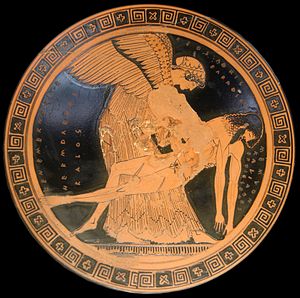
The so-called "Memnon pietà": The goddess Eos lifts up the body of her son Memnon (Attic red-figure cup, ca. 490–480 BC, from Capua, Italy) Courtesy ofWikipedia 

The statues of Mary with the body of her son Jesus that I’ve seen in Ireland always make me think of Brigit and her son Rúadán and in fact the Christian Pietà may have its origin in ancient depictions of the Greek legend of Eos and Memnon.


Pietà of Tubądzin c. 1450 Courtesy of Wikipedia


Goddess of Springtime

The Agniṣṭoma, the Vedic springtime festival at the beginning of the year, began with songs to Uṣas. (West, p 225) Elsewhere too the Dawn goddess was associated with a springtime festival. West comments that many IE peoples had a festival to celebrate the returning warmth of the sun and traditionally people would rise at or before dawn to greet the sun. It would therefore be natural for the dawn goddess to be the subject of more veneration at this time of the year. He later states that:

"The plainest example of the Dawn goddess’s becoming attached to a single festival, and that in the spring, is that of the Anglo-Saxon Eostre and her postulated German counterpart Ôstara, who have given us Easter and the Ostertage. Our source [Bede] does not connect Eostre with dawn, but that is undoubtedly the meaning of her name. (West, p 227)

Brigit’s festival, as we know, is earlier than Easter, at the very beginning of spring, when the light of the sun is just starting to visibly strengthen. To my mind, if Dawn were to be associated with a spring festival, the very start of the season would have a logic to it since dawn is the very beginning of the day.

Dawn as Upholder of Cosmic Law

Because he sees all, the Sun is witness to all and was widely known to be invoked as a witness of oaths. (West, p 200) Moving rightways with the sun is also of major importance as an expression of cosmic order and truth. In the Rig Veda Dawn, who resides on high, also upholds cosmic law:

"Truly she followeth the path of Order, nor faileth, knowing well, the heavenly quarters." (RV 1 124 3, Griffiths)

"Foe-chaser, born of Law, the Law's protectress, joy-giver, waker of all pleasant voices." (RV 1 113 12, Griffiths)

This resonates with me, at least, since I believe that Brigit, as a woman of wisdom, calls us to uphold the Truth, the right order of things.

Like the Sun, the Dawn looks down on all alike:

"She, verily, exceeding vast to look on, debarreth from her light nor kin nor stranger.
Proud of her spotless form she, brightly shining, turneth not from the high nor from the humble." (RV 1 124 6, Griffiths)

For those who consider that Brigit has connections with the law and justice, perhaps in the guise of Bríg ambue (the jurist who is said in the Irish law tracts to have intervened in or corrected judgements made by Sencha, king Conchobar's judge) these attributes of Dawn may be potent.

Dawn as a Provider of Riches

Finally, Uṣas, like Brigit, is a provider. First of all she brings Light and Life and by extension the plenty that accrue from them:

"Arise! The breath, the life, again hath reached us: darkness hath passed away and light approacheth.
She for the Sun hath left a path to travel, we have arrived where men prolong existence.
Singing the praises of refulgent Mornings with his hymn’s web, the priest, the poet, rises.
Shine then to-day, rich Maid, on him who lauds thee, shine down on us the gift of life and offspring."
 (RV 1 113 16-20, Griffiths)

Perhaps the idea of a goddess as midwife might have developed from the concept of one who is herself reborn each day and then awakens mortals into life?

Conclusions

There is an inscription at Corbridge on Hadrian’s Wall to caelestis Brigantia, celestial or heavenly Brigantia, which would be consistent with a Dawn goddess who is seen on high – the High One. In the past I’ve considered that it might refer to a sun goddess but a dawn goddess is just as possible.

Considering the idea over the course of this post, I find myself persuaded that there is something tangible here, that being a goddess associated with the dawn is part of Brigit’s story, though buried in the mists of time. 

In some medieval Irish texts Brigit is compared to the sun rather than the dawn. For instance, in two of the Lives, a wizard prophesies, on hearing the sound of Dubthach’s chariot, that Dubthach’s bondmaid Broicsech will give birth to a daughter “conspicuous, radiant, who will shine like a sun among the stars of heaven” and the 11th c hymn Brigit Bé Bithmaith says:

Brigid, excellent woman,
Flame golden, sparkling,
May she bear us to the eternal kingdom,
(She), the sun, fiery, radiant!  

Also, her four-armed cross has been identified with a ancient symbol of the sun. However it could well be that in later times the dawn goddess developed into a goddess of the sun. In Homer, the dawn goddess Eos accompanies Helios, the sun god, throughout the day, and she sometimes stands in for him. There is also some identification or confusion of her with Hemera, the Greek goddess of the day, and later retellings assign Eos's myths to Hemera. Something similar might well have happened in Irish tradition. We should remember though that images of fire and the sun are not unique to accounts of St Brigit and appear in other descriptions of Irish saints and heroes.

None of the material here amounts to evidence that Brigit or Brigantia was at one time known as a goddess of the Dawn – it is suggestive rather than conclusive, poetic rather than systematic. I’ll leave you with words from Ruth Bidgood’s Hymn to St Ffraid (Brigit’s name in Wales) from the collection Symbols of Plenty,which describes the situation beautifully:

   It is fitting that you
   should be saint of poets,
   you are mysterious, as a poem is.
   We cannot say of you
   she is exactly this or exactly that,
   or name with certainty your origin,
   or set limits to your meaning.
   You were a poem waiting to be written.
   Found and revealed,
   you make for us
   resonances with things nameless,
   deep, ancient and to come.

May Brigit shine her lovely face upon you and awaken you to happiness!


Sources

M L West, Indo-European Poetry and Myth, Oxford University Press, 2007

The Rig Veda, An Anthology, translated by Wendy Doniger O'Flaherty, Penguin Books, 1981

The Rig Veda, translated by Ralph T. H. Griffith http://en.wikisource.org/wiki/The_Rig_Veda/

The Second Battle of Mag Tuired, translated by Elizabeth A Gray, 2003 http://www.ucc.ie/celt/online/T300010.html

Donald Alexander MacKenzie,Wonder Tales from Scottish Myth and Legend, Dover Publications Inc., 1997

Ruth Bidgood, Symbols of Plenty, Canterbury Press, 2006


Thursday, 8 March 2012

International Woman's Day


 I see it as part of my connection with Brigit to support women and women's rights. This is an inspiring video by ActionAid showing some of their work with women on three continents:

http://www.youtube.com/embed/mF0LS4BPlrU

Please watch it to see both some of the difficulties and injustices women face across the world and what can be done to help them. (For some reason, I couldn't get it to embed but please take a moment to follow the link.)


Celebrate International Women's Day!


Friday, 27 January 2012

Vasant Panchami and the Feast Day of Brigit


Today, January 27th, here in Wales, is the day of the puja (worship or reverence) of Sarasvati, a sister goddess to Brigit. (You can find out which day it is in your part of the world on this website.) Vasant Panchami is celebrated on the fifth day of the waxing moon period of Magh (the month of January-February) in the traditional Indian calendar. In 2017, the date will be February 1st which is also the feast day of Brigit.
Sarasvati is the goddess of thought, memory and creative intelligence. These give rise to culture and so, not surprisingly, Sarasvati has become the goddess of culture. She is the inspiration behind the arts, often invoked by poets, but also associated with music, dancing and science. She is usually depicted with a vina or lute, and a sacred book. Books, pens, musical instruments and gurus are worshipped on this day and pictures and statues of her are put up in educational establishments.  Tradtionally children were taught to write their first words at Vasant Panchami and she is venerated in schools. The following song is sung to her: 
O Divine Virtuous Goddess Sarasvati. We bow to your feet. O Goddess of Speech, the all-pervading with cosmic vibrations, we surrender at your Divine feet. 
O Goddess, shelter to the seeker, blessed of the Three Worlds, worshipped by divine seers. Your melody is with the nine aesthetic senses and divine poetry, adorned by the varied tastes of learning. 
O the one seated on the throne of swan, O the one endowed by white complexion pure as snow and moon, the one seated on the white lotus, remove from us lethargy and expand our horizon of vision. 
O Goddess, you are the embodiment of artistic skills and string of knowledge. O the one holding the divine book of learning and the vina, we submit ourselves in entirety at your lotus feet. O Goddess, remove from our minds the poison of hatred.
Vasant Panchami, like the feast day of St Brigit, marks the end of winter and the beginning of spring. The colour yellow is symbolic of the festival, expressing the brightness and vibrancy of life and nature. People wear yellow clothes and give yellow flowers as offerings and gifts. A special delicacy is made which is coloured yellow by saffron and also contains nuts, cardamum, sugar and flour.
The puja tray is an important part of everyday devotions to the deities. Here is an excerpt from the website http://atschool.eduweb.co.uk/carolrb/hinduism/puja.html explaining which objects are placed on the tray and what they symbolise as well as what devotions at the evening session consist of:

  1. A pot of water for ritual cleansing.
  2. A bell to call the family to worship. [Others say it is to let the deity know they have come to worship and invite her into their home.]
  3. A tiny pot of the red gum gum paste to mark the forehead. This mark means that a woman's soul (her husband) is with her. [Others say they mark the forehead of the statue as a mark of respect and devotion to the gods and mark their own forehead as a sign of the blessing of the deity.]
  4. An arti lamp for the arti ceremony where everybody passes their hands over the lighted lamp and then over their forehead to make them feel closer to God.
  5. An incense burner or joss stick holder.

The evening session will be a much longer session and will include reading of holy books, discussions, teaching, meditation and prayer. Hindu parents spend a lot of time teaching their children about their religion.
Many Hindus meet for festivals at temples or mandirs, but most prayer is within the family at the family shrine. There is no need for regular church meetings for the congregation.
In the puja Hindus use their senses to make them feel close to God. They use music and chant the aum to make their ears aware of God. They use beautiful images to make their eyes aware of God. They burn ghee butter and incense to make the air smell sweet so that people focus on God. Specially prepared sweets and foods are part of ceremonies so that helps Hindus think about God. Finally the arti ceremony is where the sense of touch is stimulated to make people think of God.
Sarasvati has four arms, symbolising ego, intellect, alertness and mind. She is often shown as above, sitting on a white swan, a symbol of purity, or a lotus, symbol of transcendence. When her vehicle is a peacock it is said by some to mean that a strong ego can be reigned in by wisdom.
Those of you who are familiar with Brigit as goddess and saint will see that there are many similarities between these goddesses. I have explored them more fully in the article Brigit, Sarasvati and the Sacred Word, on my website, Brigit's Forge.
Today happens to be the start of my shift as a flame-keeper and well-tender for the group Nigheanan Brighde so I decided that after I'd lit the flame and recited the group prayer I'd also honour Sarasvati tonight. I put a statue of her on my shrine, and rang a bell I keep in the small cupboard that my limestone carving of Brigit rests upon. I offered rosemary and parsley as flowers, along with oats instead of rice, and rice-cakes with strawberry jam instead of the usual delicacy, lit some Indian cone incense and put water in Brigit's swan vase for ritual cleansing. Finally I used some red paint from my paintbox to dab on my forehead and recited the prayer as above. It was a beautiful small ceremony and ringing the bell and placing the red spot on my forehead felt especially potent. I hope Brigit approves and enjoys the company of her sister deity this night.