Gelli Fach

Gelli Fach

I'm a cell, I'm fragmented, I change my form;
I'm a repository of song, I'm a dynamic state.
I love a wooded slope and a snug shelter,
and a creative poet who doesn't buy his advancement.

Wyf kell, wyf dellt, wyf datweirllet;
wyf llogell kerd, wyf lle ynnyet.
Karaf-y gorwyd a goreil clyt,
a bard a bryt ny pryn y ret.


From: Legendary Poems from the Book of Taliesin, edited and translated by Marged Haycock


Monday, 2 May 2011

May and Canu Haf/Summer Carols


Verses of the Months 

The month of May, the ploughman is extravagant;
every dyke is shelter to the destitute;
joyful is the lightly clad old man;
the wood is leafy, the wanton is glad;
reconciliation is easy where there is love;
tuneful are the cuckoo and the hound;

Mis Mai, difrodus geilwad,
klyd pob klawdd i ddigarad;
llawen hen diarchenad;
hyddail koed, hyfryd anllad;
hawdd kymod lle bo kariad;
llafar koc a bytheiad;

Welsh, c. 15th century


Canu Haf/Summer Carols

The Middle English word 'carol ' comes from Old French 'carole', meaning 'a dance in a ring' or a 'joyous song' and it wasn't until 1502 that it was first noted to mean a Christmas hymn. Summer carols seem to have been more popular in Wales than in England and were sung in houses as well as churches and chapels; some of the old carols call on friends and neighbours to sing together a song of thanksgiving for summer days.

Here's a summer carol called Mwynder Mai/the Sweetness of May. The tune was first published in The Welsh Harper in1848.  T. Gwynn Jones wrote a song to go with it:


(I've just realised that the second note should be a C and not a D!  Unfortunately I don't have the software to change it any more. Click to enlarge.)

 
The Sweetness of May

The wizard of May is out riding unseen,
He captures the land with a network of green;
Soft waves of bright sunlight sweep over the leas,
And summer-time songbirds make merry the trees.

Though summer must languish and winter be long,
Though brief be the season of sunshine and song,
Though sorrow still tarries when happiness dies,
Sweet May is the promise of God's Paradise.


Mwynder Mai

Daw dewin y Mai heb ei weled, fin nos,
Gan wasgar ei liwiau ar weirglodd a rhos;
Bydd heulwen y bore yn dawsnio ar dwyn,
A daw ar adenydd lawenydd i lwyn.

Er oered fo'r eira, er garwed fo'r gwynt,
Er byrred ei rwysg fydd yr haf ar ei hynt,
Mewn byd sy mor gymysg o fethiant neu fai,
Rhyw awr o Baradwys yw mwynder Mai.

Written and translated by T. Gwynn Jones

Thursday, 7 April 2011

April, Hares and St Melangell


Leaping Hare: original limited edition print  © Jenny Fell
prints and cards available from the artist

from The Verses of the Months

The month of April, the upland is misty,
the oxen are weary, the earth is bare,
feeble is the stag, playful the long-eared (hare);

Mis Ebrill, wybraidd gorthir,
lluddedig ychen, llwm tir,
gwael hydd, gwareus clusthir...

Verses of the Months, Welsh c.15th century


excerpt from Pilgrimage to Melangell's Healing Centre by Noragh Jones

Third day -  arriving at Melangell's shrine and Cancer Help Centre, nestling at the head of a green valley. The church stands in a pre-christian circular enclosure. There was a healing well nearby, but now it's been fenced off and privatised by a new owner.

This is the end of my solitary pilgrimage. I meet friends and talk too much the way you do when you've been alone. Then we catch ourselves out and sit quietly in the church for an hour - praying or not praying according to our lights.

On the oak rood screen Melangell is saving a hare from the Prince of Powys's hunting party. All around the church are carvings of happy hares finding sanctuary under the saint's cloak. (The locals call hares wyn bach Melangell - Melangell's lambs).

I read in the visitor's book a moving record of hundreds of pilgrims who have come here and found the help they needed - to go on living or to face dying. I am lost for words. I go and sit in silence at Melangell's shrine.

ar ei allor                                   (on her shrine
hen gath yn eisted                       an ancient cat sits
ac yn canu grwndi                       purring)

Later we go out into the churchyard. The yew trees they say are two thousand years old. Their broken trunks bleed red sap. But they go on offering shelter to whoever comes - faith or no faith.

rym ni'n cymry ein tro                 (we take it in turns
profi tragwyddoldeb                     trying on eternity
yn yrywen gau                               in the hollow yew)


From Stone Circles: Haiku and Haiku Prose by Noragh Jones;

Sunday, 27 March 2011

True Poetry and Ecology: The White Goddess Revisited


The first time I came across mention of Brigit, goddess of poetry, healing and smithcraft, was in Robert Graves’ book, The White Goddess, which I happened upon in the library of the six-form college I went to. This book was to have a huge influence in shaping my subsequent life and my spine still tingles reading the sentence “My thesis is that the language of poetic myth anciently current in the Mediterranean and Northern Europe was a magical language bound up with popular religious ceremonies in honour of the Moon-goddess, or Muse, some of them dating from the Old Stone Age, and that this remains the language of true poetry – ‘true’ in the nostalgic modern sense of ‘the uninprovable original, not a synthetic substitute’.”

Graves’ thesis was that ‘true poetry’ is that which is loyal to the Theme, namely the story of the birth, life, death and resurrection of the God of the Waxing Year. This God fights with his rival, his twin or other self, for the love of the Three-fold Goddess, “their mother, bride and layer-out”. The God of the Waxing Year becomes the God of the Waning Year, is beaten by his rival/twin and dies but is reborn as his other self. This theme was borrowed from The Golden Bough by the Scottish anthropologist, James Frazer, and adapted by Graves to express his own personal mythology in which the Goddess is the Muse and the poet is the God of the Waxing Year. All true poetry expresses some part of this story (which Graves believed was a fundamental part of our psychic inheritance) or evokes the presence of the Goddess when “owls hoot, the moon rides like a ship through scudding cloud, trees sway slowly together above a rushing waterfall, and a distant barking of dogs is heard; or when a peal of bells in frosty weather suddenly announces the birth of the New Year”.

In the Golden Bough this cycle represented the religious beliefs of fertility cults, in which the god mated with the earth goddess, died at the harvest and was reincarnated in the spring. Graves lived on the north-west coast of the island of Mallorca where life was still ruled by the old agricultural cycle and he commented that what he wrote would read “very perversely and irrelevantly” to people who were attuned to a more industrial way of life. He had an instinctive mistrust for the growth of industry in the West and its associated values:

“…we have come to be governed, in practice, by the unholy triumdivate of Pluto, god of wealth, Apollo, god of science, and Mercury, god of thieves. To make matters worse, dissension and jealousy rage openly between these three, with Mercury and Pluto black-guarding each other, while Apollo wields the atomic bomb as if it were a thunderbolt…”

According to Graves, the function of true poetry is the religious invocation of the Muse; its use is “the experience of mixed exaltation and horror that her presence excites”. He saw this as having been once a warning to man that he must “keep in harmony with the living creatures among which he was born, by obedience to the wishes of the lady of the house” but in his day (he was writing in 1960), the warning had been ignored so that the “prime emblems” of poetry were being dishonoured. Nowadays, he said, “serpent, lion and eagle belong to the circus-tent; ox, salmon and boar to the cannery; racehorse and greyhound to the betting ring; and the sacred grove to the saw-mill… the Moon is despised as a burned-out satellite of the Earth and woman is reckoned as ‘auxiliary state personnel’. Money “will buy almost anything but truth, and almost anyone but the truth-obsessed poet.”

In the last chapter of the book he talks about the suppressed desire of Western people for the return of the goddess and foretells ecological disaster if it is postponed, for the longer it is:

"… and therefore the more exhausted by man’s irreligious improvidence the natural resources of the soil and sea become, the less merciful will her five-fold mask be, and the narrower the scope of action that she grants to whichever demi-god she chooses to take as her temporary consort in godhead."

True poet that he is, he placates her with a poem, the last stanza of which warns:

At dawn you shall appear,
A gaunt, red-wattled crane,
She whom they know too well for fear,
Lunging your beak down like a spear
To fetch them home again.

***

To me the White Goddess is an extraordinary book, filled with power and inspiration. A lot of the scholarship has been shown to be flawed and Robert Graves’ intuitions and theories have given rise to some popular misconceptions which have become part of neo-pagan lore – such as the ogham tree calendar and the image of a triple moon-goddess, maiden, mother and crone, as a basic goddess underlying all European – and therefore Celtic - goddesses. It is not taken seriously by scholars and has become discredited now among many Celtic pagans, particularly Reconstructionists. To be fair to Graves, he himself said that he didn’t trust his historical intuitions any further than they could be accurately checked. (He appealed for feedback from Celtic scholars but was disappointed not to receive any.)

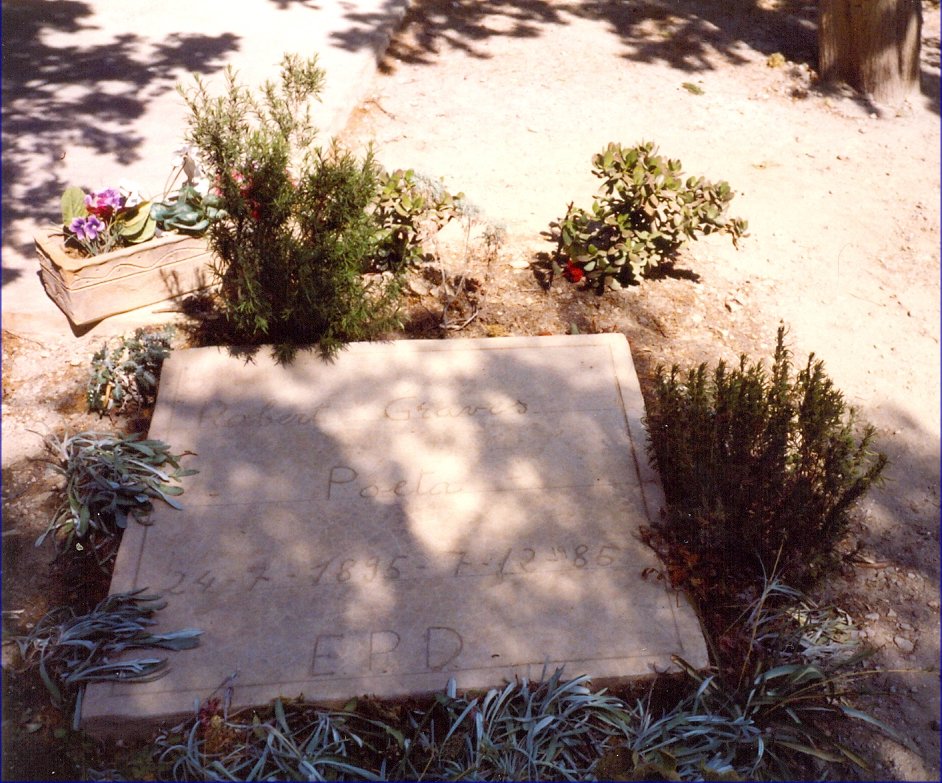
Robert Graves burial place in the churchyard in Deià (Click to see detail)

However it has been a hugely influential book, perhaps, as a single source, the most important for encouraging the return of the goddess and bringing the treasures of Welsh and Irish mythological and poetic sources to a generation hungry for their sacred insights and practices. The book was double-edged in propagating misconceptions about Celtic texts but at the same time encouraging many to learn more, promoting Celtic studies, and I would argue that its legacy is positive rather than negative in this respect. Alexei Kondratiev, rather to my surprise, agreed with me and I notice that in his book The Apple Branch, he concurs with Graves’ intuition that the thirteen lines of Irish Song of Amergin relates to the thirteen moons of the lunar year and the imagery of each line describes some attribute of the different moons.

So as well as giving credence and form to my perception of nature and the land as sacred, The White Goddess was the first book to introduce me to an ecological awareness as well as to Irish and Welsh mythology in general and Brigit in particular. The book also enhanced my perception of poetry as a magical language.

After six-form college I went on to university to read English and, having taken the poetry module, wrote a dissertation on ‘The White Goddess in the Poetry of Robert Graves'. I decided to hitch-hike to the island of Mallorca where he lived to visit him in the summer break before my final year and talk to him about it. He was away in London when I arrived but I eventually came across him at the post office and we went back to his study, talked about the dissertation and he showed me his latest poems – a wonderful encounter. I visited many times subsequently but that first meeting as the proverbial snotty-nosed undergraduate was, of course, the most precious.

I fell in love with the village of Deià where he lived: its turquoise-blue sea, mountains rosy in the evening light, the tinkling of bells as the sheep wandered among the olive groves on the hillside going down to the cove, the church perched on the hill at the top of the village which Robert believed was originally the site of a temple to Diana… it seemed like paradise to a girl raised on the flat lands of East Yorkshire, knowing only the great North Sea which was completely different in character to the Mediterranean, being cold and grey and inhospitable.

The hilltop church at Deià

I wasn’t the only person to be attracted to the village by Robert and The White Goddess – I remember in particular an American girl arriving on the rickety bus from Palma one afternoon. As she came down the steps of the rickety old bus, her small brown suitcase fell open and the contents spilled out onto the road – there among her jumbled clothes was the small Everyman copy of the Mabinogion, identical to the one I had at home. I returned to the village after finishing at university and lived there for a few years before going back to England to join my partner in London and have a child. I visited rarely and haven’t been back for over 20 years although I still sometimes dream about it. After a few years in London - not being a city girl - I moved to Wales, inspired again by The White Goddess, and have been here ever since.

Women and poetry

Graves’ Theme is, as I have said, a personal theme which is suited to a hetero-sexual male and leaves rather open to question the role of the woman poet. Woman is not a poet, he declared at one point, “she is either a Muse or she is nothing”! But then he seemed to relent and said that this didn’t mean a woman shouldn’t write poems but that she should write as a woman, “not as if she were an honorary man”. Although good advice this still meant, for him, writing as he thought a woman should be: “A woman who concerns herself with poetry should…either be a silent Muse… or she should be the Muse in a complete sense: she should be in turn Arianrhod, Blodeuedd and the Old Sow of Maenawr Penardd who eats her farrow…She should be the visible moon: impartial, loving, severe, wise”. He thought that domesticity was anathema to the poet and the Muse and that the White Goddess was always ‘the other woman’. As for motherhood: "...if a woman-poet can get a healthy child in exchange for the gift of poetry, why not?" So his view of the Goddess and the woman poet might be said to be rather prescriptive!
Naturally, for all his vision and insight, he couldn’t totally escape being a product of his time, his upbringing and his experiences. He was gracious enough to recognise that one’s relationship with the Goddess was none of his business and for me, what is important is his recognition that the marginalisation and exclusion of the feminine was a cause of great harm and danger to us and the ecosystem of which we are a part, his weaving together of mythology and poetry and his understanding of the magical nature of poetry:

“True poetic practice implies a mind so miraculously attuned and illuminated that it can form words, by a chain of more-than-coincidences, into a living entity – a poem that goes about on its own (for centuries after the author’s death, perhaps) affecting readers with its stored magic…the source of poetry’s creative power is not scientific intelligence, but inspiration…”

So I celebrate The White Goddess and think it deserves more credit than it gets these days. It is perhaps not the best book to read if you want an introduction to Celtic Studies or Celtic Reconstructionism but if you want to explore mythology, poetry and many ancient Irish and Welsh texts in the company of someone with an extensive knowledge of them, a formidable intelligence, poetic vision and iconoclastic ideas, then I recommend it thoroughly.

Wednesday, 9 March 2011

March and Dewi Sant


from The Verses of the Months

The month of March, great is the pride of birds,
bitter is the cold wind over the end of the ploughed field;

Mis Mawrth, mawr rhyfic adar,
chwerw oerwynt ar ben talar;
Welsh, c 15th century


Dewi Sant

Mosaic in Westminster Abbey

March 1st, the day of his death, is the feast day of St David or Dewi Sant - the patron saint of Wales. Tradition states that his birth was foretold to his father, Sant, by an angel while he was out hunting one day. The angel prophesied that he would find a stag, a salmon and a hive of bees by the river Teifi. He was told to take these to Maucannus’ monastery where they would be kept for David. In the Latin lives, the interpretation of this is that they signify David’s power over ancient serpents, his wisdom and his abstinence. Linked with this is the story that Patrick wanted to settle in Glyn Rhosyn but was told by an angel that he must, in the words of a cywydd by Ieuan ap Rhydderch, “leave the land which was kept by holy God for blessed Dewi” (gadu’r tir a gadwyd/ O Dduw lân I Ddewi lwyd). Patrick departed in tears but was given the care of Ireland instead.

No-one is sure how David came to be patron saint of Wales but it is recorded in his Lives that he was chosen as the chief saint at the Synod of Brefi. This Synod was attended by the great and good, religious and secular, and it was decided that each of the clergy would preach in turn and the one who could be heard by everybody would become the chief and would be made archbishop. David didn’t attend at first, but after repeated messages and the threat of fasting, he went. None of the others had been able to be heard by the crowd, in spite of standing on a pile of garments. David merely stood upon a handkerchief (or perhaps a shroud) belonging to a young boy he had raised from the dead and the land rose under him, forming the hill in Llanddewi Brefi where the church now stands. He was renowned as a preacher and being raised up, everyone could hear him. A dove sat on his shoulder while he preached at the Synod and doves had taught him his books. Not surprisingly, the Dove is one of his symbols.


In the Armes Prydein or the Prophecy of Britain, an early 10th century Welsh poem from the Book of Taliesin, David is the only saint to be named. The poem relates how the Brythonic people allied themselves with the Scots, Irish and Dublin Vikings and, under the Welsh leaders Cadwallon and Cadwaladr, vanquished the Anglo-Saxons from Britain. The author is thought to have been a member of one of St David’s monasteries so this may be why David is given such prominence. Possibly this poem helped to place him in a leading position in Wales.

Leeks are another symbol of St David and have been associated with Wales since at least the time of Henry VIII. There is a tradition that David told the Welsh soldiers to wear a leek in their hats when they fought a battle against the Saxons and were victorious. Another tradition says that the Black Prince gave them to the Welsh soldiers to wear at the battle of Crécy. (I am sure that I have read an account, possibly in a herbal or medical text, that leeks worn in battle would make the warrior invisible or impervious to injury. As yet I’ve been unable to locate it but if I have remembered correctly, it might explain this use of them. I’ll keep searching.)

When he decides where to settle in Wales, David has an encounter with a prince called Boya which is somewhat reminiscent of Patrick’s confrontation with the druids at Tara in Ireland. It is said that David lit a fire and the smoke encircled the whole of the island, extending even to Ireland. Lighting a fire in this way was a recognised way of staking a claim to land. The Welsh laws call the right to dwell on inherited land dadannudd, the uncovering of the fire, and into comparatively recent times, someone who could build a house overnight, a tŷ unos, and light a fire in it making smoke rise out of the chimney by dawn, would have the right to the land. In Ireland too, the lighting of a fire on the land was a prerequisite to claiming ownership of it.

A new mosaic of St David, by Welsh artist Ifor Davies, at Westminster Cathedral was blessed by Pope Benedict XVI when he visited the UK in September. The stone at the bottom of the mosaic is from Llanddewi Brefi, the spot where the miracle of the rising of the land is supposed to have happened.


The Pope, who had been unable to visit Wales, blessed the mosaic with water from the holy well of St Non, David’s mother, and had this to say about St David:

Saint David was one of the greatest saints of the 6th century, that golden age of saints and missionaries in these isles, and he was thus a founder of the Christian culture which lies at the root of modern Europe. David's preaching was simple yet profound: his dying words to his monks were, 'Be joyful, keep the faith and do the little things'. It is the little things that reveal our love for the one who loved us first and that bind people into a community of faith, love and service. May Saint David's message, in all its simplicity and richness, continue to resound in Wales today, drawing the hearts of its people to renewed love for Christ and his Church.
He ended with a few words of Welsh: Bendith Duw ar bobol Cymru! God bless the people of Wales!

Germaine Greer, writing about the mosaic in the Guardian, was not happy. She lamented that church art is now “feeble, derivative and kitsch” and thought that people “who are capable of the heroic acts of faith required of today's Catholics should not be mocked by being fed such meretricious pap.” I won’t comment on the art (except to say that I’m a sucker for things that sparkle!) but it’s nice to see a young St David with a contemporary face.

There’s a rather lovely Green Man carving in St David’s Cathedral in Pembrokeshire, under one of the choir seats.


And to end, as I've mentioned before, there's a picture of Dewi as a boy with St Non, his mother, in the double window in the church of Llansantffraed in Llanon, alongside Ffraed. (Click on any of these pictures to enlarge them.)


Tuesday, 1 February 2011

February and an Irish Imbolc poem

St Bride by Margaret Tarrant
                                       

The month of February, a feast is rare,
the spade and the wheel are hard at work...

Mis Chwefrol, anaml ankwyn,
llafurus pal ac olwyn...

The Verses of the Months, Welsh, circa 15th century


 Imbolc

Tasting every food in order
This is what behoves at Imbolc
Washing of hand and feet and head
It is thus I say.

Fromad cach bíd iar n-urd,
issed dlegair i n-Imbulc,
díunnach laime is coissi is cinn,
is amlaid sin atberim.

(From an Irish calendar poem in Hibernica Minora, edited by Kuno Meyer,translation by Kenneth Jackson.)

Tuesday, 25 January 2011

Urthona: the arts and the sacred

  
I came across Urthona [if you get diverted repeatedly, as I did, to a Dharma Link website, scroll down to the Urthona link] when the editors were doing an issue on Celtic Connections and asked if they could use an article of mine on Brigit. Urthona describes itself as a journal of Buddhism and the arts but has much to offer those who aren't Buddhist but are interested in the arts and the sacred; I think it deserves to be better known than it is.

The name is taken from Blakes's spirit of the Imagination, Urthona, one of the four Zoas. Information in the front of the journal tells us that "In his temporal form Los, Urthona is the archetypal blacksmith who labours in his forge to beat out forms which will awaken mankind from spiritual slumber and remind us that this world is 'all one continued vision of Fancy or Imagination'.

"The journal seeks to present the work of artists and thinkers who:

Express the sacred dimension of the arts in ways which are relevant now.

Embody in their work the unlimited possibilities of human consciousness; its potential for insightful, sympathetic appreciation of nature, humanity and all forms of life.

Illuminate or embody the Buddhist notion of cultural disciplines as a Way, a means towards finding our true nature, that which is boundless and unconditioned.

Critical of the pervasive nihilism of our age, but aware equally of the dangers of falling into fixed systems of metaphysical views, the writers here explore (in the words of poet Peter Abbs) the 'suspended, open, precarious nature of spirituality'."

The current issue on Art, Ecology and Insight I found particularly uplifting and thought-provoking - it filled the day it arrived with beauty and inspiration. I especially enjoyed articles by:

Ratnagarbha on Buddhism, Blake and Deep Ecology

"The ancient view that the entire universe is alive, and that the worlds of mind and matter are not ultimately separate, is at the heart of the new discipline of Deep Ecology. Ratnagarbha discovers that both the cosmology of the Romantic poet William Blake and the world view of Buddhism have much to offer the ecology movement."

Vishvapani on Buddha in the Forest

"Vishvapani, author of a new book on the life of the Buddha, explores the neglected topic of the Buddha's relationship with nature" concluding that "The monks of the Theragatha... express a deep intimacy with the natural world that is born of long years spent outdoors, living beneath the stars and amid the animals and spirits. They don't sentimentalise nature and are all too aware of its perils, discomforts and snares, but neither do they reject it.
This intimacy is also the key to Gautama's changing relationship with the non-human world. he saw through his culture's terror of the wilderness by becoming intimate with his mind and finding within it the roots of terror. Then he was able to become intimate with nature itself.
His lesson to us is this: to heal our relationship with the natural world, we must heal ourselves."

Dhivan on Conscious Surrender to the Beautiful, an introduction to Sangharakshita's The Religion of Art

"In The Religion of Art, Sangharakshita explores the possibility of a unifying vision that embraces both passions [those of the Arts and of  Buddhism with its teaching of a path to liberation and truth] to find the truth in beauty and the beauty in truth." The article quotes Lama Govinda who wrote: Therefore wherever religion is a living force there it finds its natural expression in art, in fact, it becomes art itself - just as art in its highest attainments becomes religon. Art is the measure of the living quality of a religion." [my italics]

Vajradarshini on Ordinary Beauty which explores the Japanese idea of Wabi Sabi

"... this isn't a beauty which lifts us above our everyday experience but the beauty which is within our experience. This is the beauty showing us reality, showing us impermanence, imperfection and insubstantiality."

Eco-artist Ratnadevi on Living on the Edge of Uncertainty

"The explicit intention of many eco-artists is to elicit in the viewer an affinity with nature. It can be argued that this reason for art-making is as old as civilisation itself, with depiction of nature taking the place of the lost immersion in it. Contemporary eco-artists not only want to restore this sense of participation in the natural world, but also attempt to mobilise the desire to preserve and protect it, engendering the spirit of deep ecology. In that they are the brothers and sisters of many indigenous art-makers and ritualists through the ages. Deep ecology seeks a radical change of perception that views nature not from a separate standpoint, but from an embeddedness within it."

Beautifully produced, there are, as always, poems, photos, artwork and reviews as well as articles A feast for the intellect, the senses and the spirit. Well worth a look!

Saturday, 1 January 2011

January and the Festival of Pongal


The month of January, the valley is smoky,
the cupbearer is weary, the wandering bard is in distress,
the raven is thin, the hum of bees is rare,
the byre is empty, the kiln is cold…

Mis Jonawr, myglyd dyffryn,
blin trulliad, trallawd klerddyn,
kul bran, anaml llais gwenyn,
gwac buches, diwres odyn…

Verses of the Months, Welsh c.15th century


***


To everyone experiencing winter – and especially those who cannot at present find summer inside themselves – here’s a beautiful and rather uplifting video to give you a vision of a warmer land on another part of our beautiful Earth- as well as some food for thought. In it Carl Sagan speculates about the nature of the universe and the gods, accompanied by images of the festival of Pongal.


The festival of Pongal comes from the South of India, especially Tamil Nadu. It is linked to the agricultural cycle and celebrates the first harvest at the time when the days are becoming longer. It is an auspicious time and a time of new beginnings. People offer a special thanksgiving to Surya, the sun god; rain; the earth and cattle – all of which play a part in enabling the harvest. Pongal comes from the word ponga which means ‘to boil’ and pongal means ‘spillover’ or 'that which is overflowing’. It is also the name of the sweet rice which is the special food of the festival. So as we experience our time of scarcity, another part of our planet experiences a time of abundance.

During the Pongal festival, people wear new clothes and throw discarded articles on the fire. In a few short months the earth will have turned again in its cycle and the sun will bless us once more. What would you like to discard with the old year and what seeds would you like to nurture until the earth turns and spring returns to the north?

May the sun radiate peace, happiness and prosperity into your life in 2011.