In a hymn
in the Rig Veda, Uṣas, the Dawn goddess, "shines forth and with her lovely
face wakens us to happiness". The feminine adjective br̥hatī meaning
‘high, great, lofty’ is applied
to her several times in the Rig Veda and, as you might know, the names
Brigantia and Brigit come from a cognate word, the feminine
PIE*bhr̥g'hntī, from a root berg'h 'high, lofty,
elevated'.
It seems
likely that the name Brigit or Brigantia is actually a title rather than a
personal name, meaning ‘high one’ – something similar to the royal title, ‘Your
Highness’. In the Indo-European (IE) tradition, among others, sometimes gods’
names were not spoken aloud because they were taboo and it was not uncommon for
them to be displaced by a title or epithet. As M L West points out in his book Indo-European
Poetry and Myth which I am drawing on in this post, we do the same
with the Christian god Yahweh, referring to him instead as Lord or Almighty
Father or simply God. J K Rowling reflects this in the Harry Potter books where
Voldemort is so feared that he is known as He Who Must Not Be Named in case
uttering the actual name will invoke his presence.
West
considers Brigit a candidate for a lost Irish goddess of the Dawn. He notes
that the details and imagery of Brigit in the saint’s Lives are in keeping with
such a goddess. She is born at sunrise, on the threshold of the house, and her
mother has a foot either side of the doorway. She is the daughter of Dubthach,
(Dark), son of Dallbrónach, (Dark and gloomy), the house she is in appears to
be burning with a fire that extends up to heaven but extinguishes nothing and
she is only able to be fed by drinking the milk from a red-eared cow - Uṣas is associated with red cows. He also mentions that she is said elsewhere to be the daughter of the
Dagda, the Good God (a statement which actually comes from Cormac’s Glossary). Uṣas is thought to be the
daughter of Dyeus (Zeus in Greek mythology), the Father god, the all-knowing
God. (West, p 218)
Dawn as the Inspirer of Poets and
Bringer of Wisdom
Reading a hymn to Uṣas in
the Rig Veda, I was delighted to find her described as the inspirer
of poets:
"Gazing out over all
creatures, the Goddess shines from the distance facing straight towards every
eye. Awakening into motion everything that lives, she has found the speech of
the inspired poet." (RV 1 92 9. O’Flaherty)
A note by the translator Wendy
Doniger O’Flaherty tells us that ‘found’ has two meanings – both that Uṣas
finds poetry for the poet, inspiring him, and finds it in him, accepting his
praise. In his glossary, Cormac describes Brigit as "the goddess whom
poets adored". It would be natural, of course, that the beauty of Dawn who
brings with her the return of the light, of the day, of the riches that the day
offers, inspires poets and is the subject of their praise.
As the bringer of light to
mortals, and bearing in mind the metaphor of light as enlightenment, dawn can
easily be associated with wisdom – and again Brigit is hailed by Cormac as a
female sage or woman of wisdom. Both Uṣas and the Greek goddess of Dawn, Eos,
are described as ‘far-seeing’ or ‘all-seeing’ and we know that the Sun god’s status
arises from his position of being high in the heavens giving him likewise the
attribute of being all-seeing as well as all-knowing (even in Christian prayers
in the Carmina Gadelica the sun is revered as the eye of God). The Dawn goddess
through her position in the heavens is all-seeing with its implication
all-knowing, wise.
Cows and
Dawn
West
considers the cow with the red ears significant because Uṣas is particularly associated
with red cows – probably a metaphor for the redness of sky at dawn.The Rig
Veda refers to both Night and Dawn as cows: “Dawn and Night are
a cow good for milking”. (It should be noted though that Brigit’s cow is white
with red ears and such animals appear elsewhere in Celtic language tales
notably The Mabinogi, the implication being that they are
Otherworldly beasts. But then why is this so? Is it because they were at one
time associated with a goddess of the heavens?)
St Brigit’s lore undeniably associates her with cows – she is a protector of
domestic animals. In one of the medieval accounts of her life she is able
to milk her cow three times to provide hospitality to visiting bishops and in
her iconography she is often shown with a cow. In milking songs in the Carmina
Gadelica she is referred to as ‘the milkmaid Bride’ and a milking blessing
(no 95) affirms that:
"The calm Bride of the white combs
Will give to my loved heifer the lustre of the swan."
"Bheir Bride bhith
nan cire geala,
Li na h-eal am aghan gaoi."l
Bride is often referred to as a
maid or maiden in the Carmina Gadelica – as is Uṣas.
Dawn and Night as Sisters
Night and Dawn are seen in
the Rig Veda as sisters, the one driving away the other. West
quotes from the Rig Veda:
"Bright
with bright calf the white one has come; the black one has vacated her seats
for her.
Cognate, immortal, consecutive, Day and Night, alternating colour, move
on…"(RV 1 113 2. O’ Flaherty)
He also quotes from Greek
literature where Hesiod states:
"Night and Day approaching
greet one another as they cross the great threshold
of bronze: the one goes in the other comes out…
the one carrying far-seeing light… for men on earth
the other with Sleep in her arms, the brother of
Death…"
while Parmenides has “There stand
the gates of the paths of Night and Day, kept apart by a lintel and a stone
threshold…”
A Latvian riddle offers “Two
sisters who are at odds; one appears, the other runs away; one is white the
other black”. (West, pp 222-223)
The Two Faces of Bride
All this reminds me of a rather
tantalising remark in Lady Gregory’s Of Gods and Fighting Men regarding
Brigit: “And the one side of her face was ugly, but the other side was very
comely”. I recognise the source of everything else Gregory says about Brigit
and though I tried following up the booklist she gives as sources at the end of
her book, I was unable to find this. It was a bit like trying to find a needle
in a haystack however and perhaps I shall try again at some point. Since I do
recognise the authenticity of the other descriptions of Brigit, I’m inclined to
believe that she had a good source for this statement, though it could have
been lore she had collected locally and so unverifiable.
There are some echoes of this
idea – of the two faces – in 'The Story of the Coming of Angus and Bride' in
Donald Mackenzie’s Wonder Tales from the Scottish Myth and Legend.
In it, Beira, who reigns over the winter is dark and old in her winter aspect
(“Why is my face so dark, so dark?”) but when she renews herself by drinking
from the Well of Youth she becomes young and beautiful with golden hair and we
are told "there is none more lovely save Bride". Beira keeps Bride
prisoner all winter but on the first day of spring she is rescued by Angus. A
battle ensues between the forces of winter, Beira, and of spring or summer,
Angus and his consort, Bride; Beira rides a dark horse, Angus a white one.
Mackenzie comments that “The story of the struggle between Angus with his
consort Bride and Beira is the story of the struggle between spring and winter,
growth and decay, light and darkness, and warmth and cold” but he does not name
sources for the story. It was published in 1917, thirteen years after Of
Gods and Fighting Men but it is a least possible that Lady Gregory had
heard of it.
Digressing rather, there is a pleasing account by the poet W B Yeats, a friend
of Lady Gregory, which shows that he was aware of the Carmina Gadelica:
“I find in my diary that on December 27, 1897, a seer, to whom I had given a
certain old Irish symbol, saw Brigid, the goddess, holding out ‘a glittering
and wriggling serpent’, and yet I feel certain that neither I nor he knew
anything of her association with the serpent until the Carmina Gadelica was
published a few months ago.” (From the essay 'Magic', quoted in A.
Norman Jeffares, Yeats: Selected Criticism, Macmillan, 1964, pp
88-8)
To return to consideration of the two faces of Brigit - in the Scottish tale
there are then two women, one old with a dark face and one who is young and
lovely, who represent the opposing forces of dark and light, winter and spring
or summer. In Lady Gregory’s description ugly and comely are not the same as
black and white of course, but they signify duality and carry the idea of a
welcome and unwelcome aspect.
These are the only two sources I’ve come across which suggest this type of
duality and neither are substantiated – but I think it is at least worth
considering that there has been a tradition of the two faces of Brigit and
if so there might have been an older concept of the light and dark sisters.
In the Rig Veda, Uṣas
herself has something of a dual nature. She is immortal, being reborn each day,
and wakens mortals to happiness, giving them the riches of the day. But she
also causes them to age, wearing away their life span because their days are
numbered. ’Bringing old age, thou hast come, O unageing Dawn. Unageing, thou
dost make to age all else’. (Taittirīya
Saṃhāta. 3. 11. 5. quoted in West, p 225) In this she is, in a sense, an
ally of Death as well as Life.
The Colours of Dawn
The IE prototype for the word dawn, *h₂ewes- (→ *awes-), is
a verbal root meaning, according to West, ‘glow, (red) flame’, related to the
Latin and Old Prussian words for ‘gold’among others. From these come
Latin aurora and Welsh gwawr. The name Eos for the
Greek goddess of Dawn, the Roman Aurora, and the Indian Uṣas are related.
(West, p 217)
In the Rig Veda Uṣas
is associated with red-gold and described as being many-coloured or
brightly-coloured. Her cows and horses are variously described as red or
red-gold, although in hymn 113.14 she awakens the world on her chariot drawn by
purple horses. Also, as in the example above, she is described as both bright
and white - 'the white one'.
Famously, Homer celebrate Eos as 'rose-fingered' and 'saffron-robed' while
elsewhere the epithets 'rose-armed' and 'gold-armed' are applied to her. The
poet Sappho calls her 'gold-sandalled Dawn. The redness described is often
qualified as a soft rose-red or golden red. These are, of course, the colours
of dawn.
Kilmeny, in her blog 'Reul-iuil Bride', has an interesting post, The Colours of Bríde, which shows Brigit is
repeatedly linked with the colours white and gold in the extant lore, rather
than the bright red we might associate her with today in current neo-pagan
narrative.
Incidentally, the picture of
Brigit at the top of this post fits very well with her as goddess of Dawn
bringing light out of the night sky, dressed in white with golden hair. I came
across it unattributed but the style is so like that by the artist Gail Donovan
in a leadlight window in Kildare College Chapel, Holden
Hill, South Australia,
"dancing the dance of the new life of creation…" (which I have on a
card given me by the Brigidine sisters in Kildare) that I assume it is by
her.
The Dawn Goddess Mourns Her Son
A rather curious and unexpected correspondence
I came across exploring the dawn connection concerns the Greek goddess of Dawn,
Eos. Eos, a Greek, has a son, Memnon, by the Trojan Tithonus. He is killed by
Achilles fighting for his father's people against the Greeks in the Trojan
War. His death is told of in the now lost epic Aethiopis,
composed after the Iliad, circa the 7th century BC but recounted in
other texts which have come down to us. Eos mourns the death of her son, in one account she prevents the sun from
rising and flees to Hades until Zeus persuades her to return. Virgil says that
when her son Memnon was going to fight against Achilles, she asked Hephaestus,
the Greek smith god, to give her arms for him. When Memnon was killed, her
tears fell down in the form of morning dew.
Compare this account with a scene
from The Second Battle of Maigh Tuiredh:
…the Fomoire… picked a man to reconnoitre
the battle and the practices of the Túatha Dé — Rúadán, the son of Bres and of
Brig, the daughter of the Dagda—because he was a son and a grandson of the
Túatha Dé… They sent him back to kill one of the áes dána, Goibniu [the smith
of the Túatha Dé]. He requested a spearpoint from him, its rivets from the
brazier, and its shaft from the carpenter; and everything was given to him as
he asked… But after the spear had been given to him, Rúadán turned and wounded
Goibniu. He pulled out the spear and hurled it at Rúadán so that it went
through him; and he died in his father's presence in the Fomorian assembly.
Bríg came and keened for her son. At first she shrieked, in the end she wept.
Then for the first time weeping and shrieking were heard in Ireland. (Gray,
paragraph 57, p 39)
In the Greek story, the Greek Eos
has a son with Memnon, a Trojan and Memnon fights on the Trojan side and is
killed by Achilles, a Greek. The Greek god Hephaestus made a weapon (or
armour in some accounts) at Eos’s request, because she is of his tribe. In
the Irish account Brig, of the Túatha Dé Danaan, has a son with Bres of
the Fomoire. Goibniu, the smith and other craftsmen of the Túatha Dé
Danaan make a spear for Rúadán because they are of his mother's
tribe. Rúadán tries to kill Goibniu but fails and is killed by him, a
member of the Túatha Dé Danaan. Both mothers grieve deeply for their sons.
It seems to me there is too much
similarity between these two accounts for it to be accidental and we know that
the Irish literati were interested in the intellectual heritage of classical
civilization and copied classical texts. If the story of Eos and Memnon did
influence this account, it is surely significant that Brig is given the role of
Eos, the Dawn goddess.
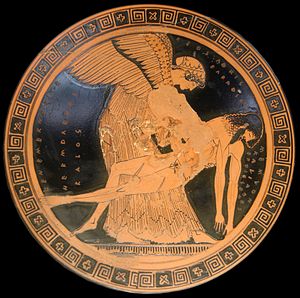
The so-called "Memnon pietà": The goddess Eos
lifts up the body of her son Memnon (Attic red-figure cup, ca. 490–480 BC,
from Capua, Italy) Courtesy ofWikipedia
The statues
of Mary with the body of her son Jesus that I’ve seen in Ireland always make me
think of Brigit and her son Rúadán and in
fact the Christian
Pietà may have its origin in ancient depictions of the Greek legend of
Eos and Memnon.
Goddess of Springtime
The Agniṣṭoma, the Vedic springtime festival at the beginning of the year, began with songs to Uṣas. (West, p 225) Elsewhere too the Dawn goddess was associated with a springtime festival. West comments that many IE peoples had a festival to celebrate the returning warmth of the sun and traditionally people would rise at or before dawn to greet the sun. It would therefore be natural for the dawn goddess to be the subject of more veneration at this time of the year. He later states that:
"The plainest example of the Dawn goddess’s becoming attached to a single festival, and that in the spring, is that of the Anglo-Saxon Eostre and her postulated German counterpart Ôstara, who have given us Easter and the Ostertage. Our source [Bede] does not connect Eostre with dawn, but that is undoubtedly the meaning of her name. (West, p 227)
Brigit’s festival, as we know, is earlier than Easter, at the very beginning of spring, when the light of the sun is just starting to visibly strengthen. To my mind, if Dawn were to be associated with a spring festival, the very start of the season would have a logic to it since dawn is the very beginning of the day.
Dawn as Upholder of Cosmic Law
Because he sees all, the Sun is witness to all and was widely known to be invoked as a witness of oaths. (West, p 200) Moving rightways with the sun is also of major importance as an expression of cosmic order and truth. In the Rig Veda Dawn, who resides on high, also upholds cosmic law:
"Truly she followeth the path of Order, nor faileth, knowing well, the heavenly quarters." (RV 1 124 3, Griffiths)
"Foe-chaser, born of Law, the Law's protectress, joy-giver, waker of all pleasant voices." (RV 1 113 12, Griffiths)
This resonates with me, at least, since I believe that Brigit, as a woman of wisdom, calls us to uphold the Truth, the right order of things.
Like the Sun, the Dawn looks down on all alike:
"She, verily, exceeding vast to look on, debarreth from her light nor kin nor stranger.
Proud of her spotless form she, brightly shining, turneth not from the high nor from the humble." (RV 1 124 6, Griffiths)
For those who consider that Brigit has connections with the law and justice, perhaps in the guise of Bríg
ambue (the jurist who is said in the Irish law tracts to have intervened in or corrected judgements made by Sencha, king Conchobar's judge) these attributes of Dawn may be potent.
Dawn as a Provider of Riches
Finally, Uṣas, like Brigit, is a provider. First of all she brings Light and Life and by extension the plenty that accrue from them:
"Arise! The breath, the life, again hath reached us: darkness hath passed away and light approacheth.
She for the Sun hath left a path to travel, we have arrived where men prolong existence.
Singing the praises of refulgent Mornings with his hymn’s web, the priest, the poet, rises.
Shine then to-day, rich Maid, on him who lauds thee, shine down on us the gift of life and offspring."
(RV 1 113 16-20, Griffiths)
Perhaps the idea of a goddess as midwife might have developed from the concept of one who is herself reborn each day and then awakens mortals into life?
Conclusions
There is an inscription at Corbridge on Hadrian’s Wall to caelestis Brigantia, celestial or heavenly Brigantia, which would be consistent with a Dawn goddess who is seen on high – the High One. In the past I’ve considered that it might refer to a sun goddess but a dawn goddess is just as possible.
Considering the idea over the course of this post, I find myself persuaded that there is something tangible here, that being a goddess associated with the dawn is part of Brigit’s story, though buried in the mists of time.
In some medieval Irish texts Brigit is compared to the sun rather than the dawn. For instance, in two of the Lives, a wizard prophesies, on hearing the sound of Dubthach’s chariot, that Dubthach’s
bondmaid Broicsech will give birth to a daughter “conspicuous, radiant, who will
shine like a sun among the stars of heaven” and the 11th c hymn Brigit Bé Bithmaith says:
Brigid, excellent woman,
Flame golden, sparkling,
May she bear us to the
eternal kingdom,
(She), the sun, fiery, radiant!
Also, her four-armed cross has been identified with a ancient symbol of the sun. However it could well be that in later times the dawn goddess developed into a goddess of the sun. In Homer, the dawn goddess Eos accompanies Helios, the sun god, throughout the day, and she sometimes stands in for him. There is also some identification or confusion of her with Hemera, the Greek goddess of the day, and later retellings assign Eos's myths to Hemera. Something similar might well have happened in Irish tradition. We should remember though that images of fire and the sun are not unique to accounts of St Brigit and appear in other descriptions of Irish saints and heroes.
None of the material here amounts to evidence that Brigit or Brigantia was at one
time known as a goddess of the Dawn – it is suggestive rather than conclusive,
poetic rather than systematic. I’ll leave you with words from Ruth Bidgood’s Hymn to St Ffraid (Brigit’s name in Wales)
from the collection Symbols of Plenty,which
describes the situation beautifully:
It
is fitting that you
should be saint of poets,
you are mysterious, as a poem is.
We
cannot say of you
she is exactly this or exactly that,
or name with certainty your origin,
or set limits to your meaning.
You were a poem waiting to be written.
Found and revealed,
you make for us
resonances with things nameless,
deep, ancient and to come.
May
Brigit shine her lovely face upon you and awaken you to happiness!
Sources
M L West, Indo-European Poetry and Myth, Oxford University Press, 2007
The Rig Veda, An Anthology, translated by Wendy Doniger O'Flaherty, Penguin Books, 1981
The Rig Veda, translated by Ralph T. H. Griffith
http://en.wikisource.org/wiki/The_Rig_Veda/
The Second Battle of Mag Tuired, translated by Elizabeth A Gray, 2003
http://www.ucc.ie/celt/online/T300010.html
Donald Alexander MacKenzie,Wonder Tales from Scottish Myth and Legend, Dover Publications Inc., 1997
Ruth Bidgood, Symbols of Plenty, Canterbury Press, 2006