Gelli Fach

Gelli Fach

I'm a cell, I'm fragmented, I change my form;
I'm a repository of song, I'm a dynamic state.
I love a wooded slope and a snug shelter,
and a creative poet who doesn't buy his advancement.

Wyf kell, wyf dellt, wyf datweirllet;
wyf llogell kerd, wyf lle ynnyet.
Karaf-y gorwyd a goreil clyt,
a bard a bryt ny pryn y ret.


From: Legendary Poems from the Book of Taliesin, edited and translated by Marged Haycock


Showing posts with label St Non. Show all posts

Wednesday, 9 March 2011

March and Dewi Sant


from The Verses of the Months

The month of March, great is the pride of birds,
bitter is the cold wind over the end of the ploughed field;

Mis Mawrth, mawr rhyfic adar,
chwerw oerwynt ar ben talar;
Welsh, c 15th century


Dewi Sant

Mosaic in Westminster Abbey

March 1st, the day of his death, is the feast day of St David or Dewi Sant - the patron saint of Wales. Tradition states that his birth was foretold to his father, Sant, by an angel while he was out hunting one day. The angel prophesied that he would find a stag, a salmon and a hive of bees by the river Teifi. He was told to take these to Maucannus’ monastery where they would be kept for David. In the Latin lives, the interpretation of this is that they signify David’s power over ancient serpents, his wisdom and his abstinence. Linked with this is the story that Patrick wanted to settle in Glyn Rhosyn but was told by an angel that he must, in the words of a cywydd by Ieuan ap Rhydderch, “leave the land which was kept by holy God for blessed Dewi” (gadu’r tir a gadwyd/ O Dduw lân I Ddewi lwyd). Patrick departed in tears but was given the care of Ireland instead.

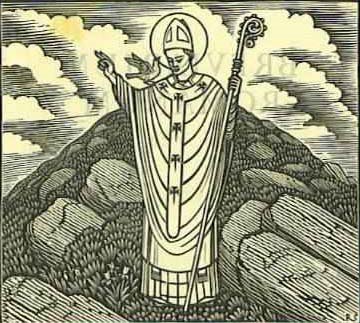
No-one is sure how David came to be patron saint of Wales but it is recorded in his Lives that he was chosen as the chief saint at the Synod of Brefi. This Synod was attended by the great and good, religious and secular, and it was decided that each of the clergy would preach in turn and the one who could be heard by everybody would become the chief and would be made archbishop. David didn’t attend at first, but after repeated messages and the threat of fasting, he went. None of the others had been able to be heard by the crowd, in spite of standing on a pile of garments. David merely stood upon a handkerchief (or perhaps a shroud) belonging to a young boy he had raised from the dead and the land rose under him, forming the hill in Llanddewi Brefi where the church now stands. He was renowned as a preacher and being raised up, everyone could hear him. A dove sat on his shoulder while he preached at the Synod and doves had taught him his books. Not surprisingly, the Dove is one of his symbols.

In the Armes Prydein or the Prophecy of Britain, an early 10th century Welsh poem from the Book of Taliesin, David is the only saint to be named. The poem relates how the Brythonic people allied themselves with the Scots, Irish and Dublin Vikings and, under the Welsh leaders Cadwallon and Cadwaladr, vanquished the Anglo-Saxons from Britain. The author is thought to have been a member of one of St David’s monasteries so this may be why David is given such prominence. Possibly this poem helped to place him in a leading position in Wales.

Leeks are another symbol of St David and have been associated with Wales since at least the time of Henry VIII. There is a tradition that David told the Welsh soldiers to wear a leek in their hats when they fought a battle against the Saxons and were victorious. Another tradition says that the Black Prince gave them to the Welsh soldiers to wear at the battle of Crécy. (I am sure that I have read an account, possibly in a herbal or medical text, that leeks worn in battle would make the warrior invisible or impervious to injury. As yet I’ve been unable to locate it but if I have remembered correctly, it might explain this use of them. I’ll keep searching.)

When he decides where to settle in Wales, David has an encounter with a prince called Boya which is somewhat reminiscent of Patrick’s confrontation with the druids at Tara in Ireland. It is said that David lit a fire and the smoke encircled the whole of the island, extending even to Ireland. Lighting a fire in this way was a recognised way of staking a claim to land. The Welsh laws call the right to dwell on inherited land dadannudd, the uncovering of the fire, and into comparatively recent times, someone who could build a house overnight, a tŷ unos, and light a fire in it making smoke rise out of the chimney by dawn, would have the right to the land. In Ireland too, the lighting of a fire on the land was a prerequisite to claiming ownership of it.

A new mosaic of St David, by Welsh artist Ifor Davies, at Westminster Cathedral was blessed by Pope Benedict XVI when he visited the UK in September. The stone at the bottom of the mosaic is from Llanddewi Brefi, the spot where the miracle of the rising of the land is supposed to have happened.


The Pope, who had been unable to visit Wales, blessed the mosaic with water from the holy well of St Non, David’s mother, and had this to say about St David:

Saint David was one of the greatest saints of the 6th century, that golden age of saints and missionaries in these isles, and he was thus a founder of the Christian culture which lies at the root of modern Europe. David's preaching was simple yet profound: his dying words to his monks were, 'Be joyful, keep the faith and do the little things'. It is the little things that reveal our love for the one who loved us first and that bind people into a community of faith, love and service. May Saint David's message, in all its simplicity and richness, continue to resound in Wales today, drawing the hearts of its people to renewed love for Christ and his Church.
He ended with a few words of Welsh: Bendith Duw ar bobol Cymru! God bless the people of Wales!

Germaine Greer, writing about the mosaic in the Guardian, was not happy. She lamented that church art is now “feeble, derivative and kitsch” and thought that people “who are capable of the heroic acts of faith required of today's Catholics should not be mocked by being fed such meretricious pap.” I won’t comment on the art (except to say that I’m a sucker for things that sparkle!) but it’s nice to see a young St David with a contemporary face.

There’s a rather lovely Green Man carving in St David’s Cathedral in Pembrokeshire, under one of the choir seats.


And to end, as I've mentioned before, there's a picture of Dewi as a boy with St Non, his mother, in the double window in the church of Llansantffraed in Llanon, alongside Ffraed. (Click on any of these pictures to enlarge them.)


Sunday, 29 August 2010

Some images of St Brigit in Wales


As I mentioned in my last post, I visited the church of Llansantffraid ym Mechain on my way to Sheffield a couple of weeks ago. The church has been much enlarged and altered since its 12th century beginnings, and walking into it, with the mellow light seeping in from the yellow glass window behind the altar, I had the impression of a large and welcoming cave. The picture in the east window is divided into three, with St Bride on the right hand of the king of heaven. She is shown as a nun with a bible and crozier, traditionally carried by bishops and abbots.


Here she is in more detail, courtesy of Paul Williment's excellent site dedicated to Brigit.

On the south wall there is a window with the heading 'Charity', given by Isabel Cumberland in 1928. On my last visit, the then vicar's wife told me that it shows St Brigit. She appears here dressed in rich robes, holding an apple. The story about Brigit and the apples illustrating her charity appears in the 9th century Bethu Brigte, translated by Donnchadh Ó hAodha, and is as follows:

32
Once she was hurrying on the bank of the Inny. There were many apples and sweet sloes in that church. A certain nun gave her a small gift in a basket of bark. When she brought [it] into the house, lepers came at once into the middle of the house to beg of her. ‘Take’, said she, ‘yonder apples’, Then she who had presented the apples [said]: ‘I did not give the gift to lepers.’ Brigit was displeased and said: ‘You act wrongly in prohibiting gifts to the servants of God; therefore your trees shall never bear any fruit.’ And the donor, on going out, sees that all at once her garden bore no fruit, while shortly before it had abundant fruits. And it remains barren for ever, except for foliage.
33
Another virgin brought her apples and sweet sloes in large quantities. She gave [them] immediately to some lepers who were begging. ‘She who brought it will be sound’, said Brigit. ‘O nun, bless me and my garden.’ ‘May God indeed bless’, said Brigit, ‘that big tree yonder which I see in your garden; may there be sweet apples on it, and sweet sloes as to one third; and that twofold fruit shall not be lacking from it and its offshoots.’ And thus it was done. As the nun went into her garden she saw the alder tree with its fruit, and sweet sloes on it as to one third.


I sat in the pew beside this window and looked towards the window behind the altar. There is a partial screen separating the nave from the chancel where the choir stalls, the altar and the window are and it effectively separates the congregation or audience from the participants in the service. It made me think about religion as performance and I wondered what it would be like to be present in that church on a sunny morning with light streaming through the window and the choir singing.

Apparently the first decorative windows appeared in Christian churches around 348 - 410 AD and are mentioned by Prudentius. Stained glass was brought into Britain via Gaulish churches and the earliest evidence goes back to 675 AD. The Gothic period saw the construction of the great cathedrals of Europe and stained-glass windows really came into their own then. Abbot Suger of the Abbey of St. Denis rebuilt his church in one of the first examples of the Gothic style. He brought in craftsmen to make the glass, believing that beautiful objects would lift people's souls closer to God. I considered how wonderful it would be to build a shrine to Brigit, Goddess of Poetry, Healing and Smithcraft, and commission a beautifully-coloured stained-glass window, aligned to the south...

After the 16th-century Reformation in Britain many stained-glass windows were destroyed because of the condemnation of idolatry but they were re-introduced during the 19th century Gothic revival.

***

My visit to Llansantffraid ym Mechain was rather hurried as I was on my way to Sheffield and wanted to get to the motorway before the rush hour. But a week later I went down the coast about 10 miles to the village of Llanon for a more leisurely visit to another church dedicated to Brigit, with the alternative spelling of Llansantffraed.


The day I went had started in a very mundane way with a trip to the Co-op to do the weekly shopping. When I'd finished the sky was beginning to brighten and on the spur of the moment I decided that it would be a good time to go and take a picture of the window in Llanon. What ensued was a lovely and rather magical experience, the sort you can never plan for but which sometimes appear like a visitation of grace. By the time I arrived at the church the sun had come out and the sky was blue. I'd bought a sandwich and went into the churchyard where there was a convenient bench leaning against the wall; there I ate my lunch while butterflies chased each other over the grave stones and a young buzzard flew overhead. Tucked away at the back of the village next to the sea, the feeling of peace was tangible and soothing.


After sitting for a while, I went into the church and took several pictures of the double window which depicts St Brigit and St Non with her son, David, the patron saint of Wales. St Ffraed is shown as 'St Ffraed, Leian', St Brigit the nun, and appears with a cow and a bowl of milk. Above her is a swan to match the dove, the emblem of St David, which is above St Non in her window. St Ffraed's robe is blue, the wimple lilac and the effect is of simplicity, unlike the robe she is wearing in the Llansantffraid ym Mechain window - the difference perhaps in iconography between 1928 and 1971 when this window was dedicated. Certainly the feeling I was given by the Llansantffraid ym Mechain windows was of Christ and the saints as formal, remote and distinctly aristocratic while these presented a much more accessible and approachable image!


The Llansantffraed double window commemorates the rare phenomenon of two female saints in one parish. According to a leaflet in the church, the remains of an old chapel dedicated to Non are thought to be in the village. The ruins are claimed to be that of the Chapel-of-Ease. Like Llansantffraed church this would have originally been a monastically-based Celtic worshipping cell. It ceased to flourish after medieval times but was affiliated to Llansantffraed church as late as the beginning of the 18th century. According to The Lives of the British Saints, a conventual foundation of St Ffraid's was said to have existed about a mile north of Llanrhystyd, on the coast, a little to the north of Llanon.

The St Non's Chapel near St David's in Pembrokeshire which I visited a few years ago, has windows representing not only St Non but also St Ffraid and St Winifred, as well as a statue of Mary with her baby son, so it has a strong feminine presence. I'll post some photos of it another time.

The stone font in the Llansantffraed church is rather lovely; it is described as 'peculiarly decorated' in the church leaflet and is probably the oldest object in the church.


The little church inside has the feel of a chapel, white-washed and simple, although the windows are colourful and rich. The east window shows the risen Christ (as, in fact, does the Llansantffraid ym Mechain church); in the Llanon window he is standing in front of a cross holding out his arms, palms upwards. Apparently this is unusual as most east windows show scenes from the Crucifixion. As the leaflet available in the church highlights, it focuses on the wonder of the Easter message and I prefer this, to the emphasis on suffering and death of the Crucifixion.

After spending some time looking around and reading the notice-board I went and sat outside on the wall, to read the leaflet. Suddenly there was a resounding tap, tap, tap. I looked up, expecting to find that someone was on the other side of the hedge hammering, but to my surprise saw a song thrush only a few feet away beating a snail against a stone on top of the wall to get at the fleshy part inside, something I've never witnessed before. The thrush seemed to have a little hideaway in the hedge with an opening out beside her anvil stone and I guessed she'd used it before to prepare her lunch. This bird with its lovely song and connection with anvils seemed an appropriate one to come across in relation to Brigit.


Photograph © Debbie Bozkurt

The Ceredigion coastal path runs alongside the church and I hope to go back with a picnic and explore a little way along it before the summer is over. In fact I decided that I'd return to the church again - using it as a place to go and talk to Brigit at special times, perhaps when I feel the need to connect with the qualities attributed to her as saint. I find that making a special journey, however short, makes the occasion more potent.

Partly what was special about this visit was that it reminded me of several rather similar visits on sun-filled days to sacred places in Ireland. The west coast of Wales is reminiscent of the west of Ireland - and there were many links between the two countries along the seaways in times past. Llanon was once the home to a ship-building works and there are many grave stones in the churchyard bearing witness to this.

I was reluctant to leave but eventually set off back up the coast. On the way I saw a sign advertising strawberry cream teas and drove a few mile up into the hills to sit outside in the sun (and wind) looking out over the green fields and hills while I drank tea and ate scones with jam and cream. They weren't as good as Uncle Leo's but the presentation and setting made up for it!


While gazing out over the Welsh landscape I pondered the nature of my relationship with Brigit as both goddess and saint... but more of that next time.


Three more good things: scones, the beauty of the landscape and one's own company.