Gelli Fach

Gelli Fach

I'm a cell, I'm fragmented, I change my form;
I'm a repository of song, I'm a dynamic state.
I love a wooded slope and a snug shelter,
and a creative poet who doesn't buy his advancement.

Wyf kell, wyf dellt, wyf datweirllet;
wyf llogell kerd, wyf lle ynnyet.
Karaf-y gorwyd a goreil clyt,
a bard a bryt ny pryn y ret.


From: Legendary Poems from the Book of Taliesin, edited and translated by Marged Haycock


Thursday, 2 January 2014

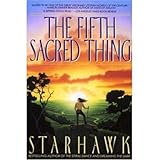
New Year Orientation: Starhawk's Five Sacred Things


Product Details


It's the start of the New Year and with the change of date there seems to come an opportunity to wipe the slate clean and steer our lives in the way we'd like them to go. Alas, within a few weeks or even days our resolutions become dissipated and scattered - at least mine usually do. By February we often don't remember them at all, becoming caught up in the duties, chores, demands and general messiness of life.

But there's still value in the exercise of orientating ourselves on the course we wish to follow; a trace will remain and may even guide our actions unconsciously at times. At the start of this year I've been re-reading some excepts from The Fifth Sacred Thing, Starhawk's novel of a Utopian, ecologically-based society and its struggle to defend itself from a military state:


Declaration of the Four Sacred Things

The earth is a living conscious being. In company with cultures of many different times and places, we name these things as sacred: air, fire, water and earth.

Whether we see them as the breath, energy, blood and body of the Mother, or as the blessed gifts of the Creator, or as symbols of the interconnected systems that sustain life, we know that nothing can live without them.

To call these things sacred is to say that they have a value beyond their usefulness for human ends, that they themselves become the standards by which our acts, our economies, our laws and our purposes must be judged. No-one has the right to appropriate them or profit from them at the expense of others. Any government that fails to protect them forfeits its legitimacy.

All people, all living things are part of the earth life and so are sacred. No one of us stands higher or lower than any other. Only justice can assure balance: only ecological balance can sustain freedom.


The Fifth Sacred Thing

Only in freedom can that fifth sacred thing we call spirit flourish in its full diversity.

To honour the sacred is to create conditions in which nourishment, sustenance, habitat, knowledge, freedom and beauty can thrive.

To honour the sacred is to make love possible.

To this we dedicate our curiosity, our will, our courage, our silences and our voices.

To this we dedicate our lives.


The Five Criteria of True Wealth

Usefulness, sustainability - meaning it must generate or save as much energy as it consumes... Beauty. Healing for the earth, or at least not being destructive. Nurturing for the spirit.

from  Starhawk: The Fifth Sacred Thing

***

In a world in which these things are not sacred - a world in which all living things are not seen as a sacred part of the earth life, a world where, as Robert Graves has said  “serpent, lion and eagle belong to the circus-tent; ox, salmon and boar to the cannery; racehorse and greyhound to the betting ring; and the sacred grove to the saw-mill… ” I think it's valuable to point our compass in the direction of these values and ideals however much we fall short, however flawed we are and however much we are implicated in the destructive, driven-by-profit ethos of the 21st century. We need to remember there is another way against which we can measure what we do. Like the stars, we won't reach them in our lifetime but we can still rise a little way towards them more strongly than if we never saw them shining.


Saturday, 21 December 2013

Winter Light


Winter Light

The sun is low and slant,
revealing the world from a different angle,
what was in shadow is now made bright.

But the light is visiting less and less:
the sleeping dark grows.

Now the glory of the trees is gone
we see their essence,
how the weather has shaped them -
this one twisted, that one bent,
turning away from the battering wind;
here one has grown rotten,
those two are standing so near
they lean together, supporting each other.

The sun shines through the branches
now leaves no longer obscure the view;
hidden landscapes open before us:
now we can see what is beyond.

Soon only a trickle of light leaks into the days
which shuffle on towards the solstice,
to the still point
where we close our eyes
and disappear

a short time

then we wake again.

Hilaire Wood 2013


Solstice Blessings! Wishing you all a very merry Christmas and may every good thing come your way in 2014.


Thursday, 5 December 2013

Hymn to Cernunnos


Hymn to Cernunnos

ambiguous god whose antlers pierce borders;
who leaps along edges
made firm by his footprints,
drumming lightning out of the earth;

who inhabits the verge of the forest,
the meeting of terrains,
where diversity burgeons
safeguarding change;

who with enticing breath
calls the snake from its hole
to hold poison in his grip and liberate plenty:
fertility of earth, the sole source of abundance;

who presides over trade and exchange,
transforms that into this
eschewing the boundaries, 
for all things are fluid
that move through his hands;

who straddles time
making measurement meaningless
and roams where leaves shiver,
moving now into darkness, now into light,
shimmers through dimensions
wearing them as his cloak;

who holds life and death
in the span of his antlers,
sinuous glides through seasons and tides
which flow always onwards,
now wild with blood’s surge,
now slowing with reason;

who requires you to kneel
at the procession of life
yet demands your full presence,
unbroken, unbowed;

whom you must attend masked,
as self and not-self,
approaching the mystery of which he is master,
human and animal, holy chimera;

who mocks the poet’s art of linear words
which seek to unite all things that oppose  -
for who but a god can reconcile opposites
and blend them within his unparalleled flesh?   


Hilaire Wood 2013 


Sunday, 17 November 2013

Autumn: A Janus Time


When I opened my curtains this morning I gasped in awe at the scene in front of me. All the different leaves of  the trees and bushes (cherry, beech, birch, forsythia, ash, blackthorn) - the flowers and plants (evening primrose, cranesbill, strawberry, iris, lady's mantle) - are decaying in their own time, at different rates and showing different colours, giving the most rich and glorious mottled effect like a Pointillist painting. The picture above, although not of the view from my window, gives you some idea.

This time last year, on an autumn walk, I was struck by the fact that the path I was walking was thick mud with discarded leaves trampled into it in places and littered here and there were acorns, beechnuts and sycamore seeds; the dying and the promise of new life both abundant. The following poem tries to express my meditation on this.


A Janus Time

Acorns and beechnuts are gracing the woods
while discarded leaves enshroud the land,
mulching the pathways yet to be walked

This is the falling time, the time of seeds,
a Janus-time of living and dying,
a threshold season.

In summer, apple-scented eglantine
frolicked in hedgerows,
yarrow and meadowsweet
brightened the verges,
an angelic presence on grey rainy days

but the wings of the sycamore fly to the future;
seeds spin our fate,
through them our lives are unfurled,
by them we are carried,
by them we are saved

This is the falling time, the time of seeds,
a Janus-time of living and dying

The offspring of plants will nurture our children,
so we are seedsmen, trading in hope,
or gamblers, reckoning the odds:
‘one for the rock and one for the crow,
one to die and one to grow’

glowing like hearth light, the promise in darkness

we live our lives on this juxtaposition,
the crux and cusp at the heart of being.

This is the falling time, the time of seeds

and now, like the trees, we are down at leaf,
heads heavy, we bend to face our roots,
feed on tubers, remember the past,
the rich earth opening -
 

what seeds do you carry that must answer the light?


**********


(I must just comment here since, I am aware that I am cross-posting on my blogs recently, that I don't intend to do this all the time of course but I've been finding it quite difficult to decide which blog to post these last few on (how to split oneself in half?) and so have put them up on both for now. I do have some posts in the pipeline which are more obviously appropriate for one or the other blog but for the time being I'll post to both when I'm undecided, although I might have to revise this in the longer term if the posts continue to converge more often than not.)


Friday, 1 November 2013

On the Death of Cats and Mothers - Poems by Thomas Hardy and Patrick Kavanagh


It's been a difficult time recently with some sad and challenging events. One of these was the death of  my cat Ash, companion of 20 years. My other cat, Willow, died last year at the age of 17. In the picture above you can see them both in happier times curled up on the end of my bed on a Sunday morning while I read the Saturday Guardian - an enjoyable Sunday morning ritual.

I remember  Chris Hamilton-Emery of Salt Publishing saying in his submission guidelines to avoid sending poems on the death of your cat, mother or Biology teacher. (Or how crap your life is. Or about bee-keeping). Happily some people have written poems when their cats have died - notably perhaps, Thomas Hardy who treated the subject with the seriousness it deserves and in doing so touched on more general themes of dealing with loss and the presence of absence.

Last Words to a Dumb Friend

Pet was never mourned as you,
Purrer of the spotless hue,
Plumy tail, and wistful gaze
While you humoured our queer ways,
Or outshrilled your morning call
Up the stairs and through the hall -
Foot suspended in its fall -
While, expectant, you would stand
Arched, to meet the stroking hand;
Till your way you chose to wend
Yonder, to your tragic end.

Never another pet for me!
Let your place all vacant be;
Better blankness day by day
Than companion torn away.
Better bid his memory fade,
Better blot each mark he made,
Selfishly escape distress
By contrived forgetfulness,
Than preserve his prints to make
Every morn and eve an ache.

From the chair whereon he sat
Sweep his fur, nor wince thereat;
Rake his little pathways out
Mid the bushes roundabout;
Smooth away his talons’ mark
From the claw-worn pine-tree bark,
Where he climbed as dusk embrowned,
Waiting us who loitered round.

Strange it is this speechless thing,
Subject to our mastering,
Subject for his life and food
To our gift, and time, and mood;
Timid pensioner of us Powers,
His existence ruled by ours,
Should - by crossing at a breath
Into safe and shielded death,
By the merely taking hence
Of his insignificance -
Loom as largened to the sense,
Shape as part, above man’s will,
Of the Imperturbable.

As a prisoner, flight debarred,
Exercising in a yard,
Still retain I, troubled, shaken,
Mean estate, by him forsaken;
And this home, which scarcely took
Impress from his little look,
By his faring to the Dim
Grows all eloquent of him.

Housemate, I can think you still
Bounding to the window-sill,
Over which I vaguely see
Your small mound beneath the tree,
Showing in the autumn shade
That you moulder where you played.    

Thomas Hardy


As for the suitability of subjects for poems, surely the quality of a poem depends not on its subject matter but on the skill and inspiration of the poet? In a few days time it will be ten years since my mother died. I haven't written a poem about her death but Patrick Kavanagh's poem in memory of his mother is a fine one I think.


In Memory Of My Mother
I do not think of you lying in the wet clay
Of a Monaghan graveyard; I see
You walking down a lane among the poplars
On your way to the station, or happily

Going to second Mass on a summer Sunday -
You meet me and you say:
'Don't forget to see about the cattle ' -
Among your earthiest words the angels stray.

And I think of you walking along a headland
Of green oats in June,
So full of repose, so rich with life -
And I see us meeting at the end of a town

On a fair day by accident, after
The bargains are all made and we can walk
Together through the shops and stalls and markets
Free in the oriental streets of thought.

O you are not lying in the wet clay,
For it is a harvest evening now and we
Are piling up the ricks against the moonlight
And you smile up at us - eternally.


Wednesday, 31 July 2013

Two Poems for British Polio Month


The Polio Pond by Ann Alexander

Couldn't get there quick enough,
legs pumping bikes
down nettled alleys,
over bomb sites and the dangerous road,
out of the light

and into this cool spinney, where
a pond of standing water waited,
still as a crouched cat.

We'd heard the polio lived here,
biding its time in mottled dark,
belonging to neither day nor night,
nor any certain thing.

That smell. Sharp underbelly stink.
Breath, in gassy bubbles
pocked the surface, where
a dead bird floated, wings outstretched.
Red ribs of a child's pram, half submerged,
told their tremendous tale.

We threw sticks, threw stones.
Well back, on guard, then inching close,
we stared into its clouded heart,
swore we saw the bloody eye,
the tentacles,
the curled chameleon's tongue.

© Ann Alexander (from the collection Too Close)


A picture of me from the local paper at the Infantile Paralysis Fellowship party in
Wakefield Town Hall 1956, on a rare outing from Pinderfields Hospital.

In 1952 I contracted polio which left me with a paralysed leg. In the 1940s and early 1950s there were major polio epidemics in Britain and naturally there was huge fear around them. The virus was thought to lurk in water and warnings were given out in schools and signs hung in public swimming-pools. As well as The Polio Pond being an excellent poem, a piece of social history and a depiction of the way children are attracted to danger, there was something about the way Ann Alexander portrayed polio as a dangerous beast rather than an invisible virus that I found very empowering.

I used to go to a pond in the overgrown garden of a deserted house, with some children from the village, when I was a child and it reminded me of Ann's pond. At a mythic level, a tale began to unfold in which I had been one of the children who didn't get away in time when the beast emerged. So I was wounded by it and also in a strange way tainted by it - which explained the fear I engendered in other children sometimes, their own fear of disability or fear about how to relate to someone who is not like them perhaps. There is a kind of power in being able to make people afraid, but also I felt curiously strengthened by the feeling that I had encountered the dangerous beast and survived - had more than survived.

The poem worked on me on various levels, showing how magical poetry and stories can be. Disability is so often about disempowerment that it's good to have a sense of the opposite in a new way. Here's a draft of my own poem written in response to Ann's (which I have copied here with her kind permission) in which I've taken the story further. I've also suggested that hate and cruelty are monstrous too.


Picture by Sulamith Wülfing


The Polio Monster

Biding its time, the pond lay watching,
a bright eye in the tangled waste;
the bars of a gate floated
dismembered and useless,
dotted with pondweed like green confetti.

The children threw stones and gobbets of mud,
their eyes gleamed, reverting to feral
and catching their offerings
the pool gobbled them down,
sent up bubbles signalling relish.

Strengthened, the monster emerged,
black slime ribboned his scales.
A dark bridegroom, he leered towards them
and all valour lost, they turned and fled,
except for the one who was left behind.

In the claws' grasp there's no time for fear,
there's only surrender, the rushing descent
into the tunnel, the muscular throat.
Claimed by the monster the girl becomes It,
scales now exchanged for an iron splint,
talons curved to the arch of a wheelchair.

Disallowed sticks, the children throw insults;
sticks and stones would break her bones
but words as well could harm her.
Yet where there’s fear there’s always power:
To become what is feared is to move beyond fear.

In the alien form she discovers her might,
feels the rush of sinewy wings
and knows her new world is still the whole world,
the monster now fled to the pools of their eyes.

© Hilaire Wood


If you have enjoyed these poems and would like to know more about the British Polio Fellowship, you can find out HERE and make a donation HERE. If you can, please spread awareness of Polio, a largely forgotten disease which still affects 120,000 people in the UK, and of the work of the Fellowship. Or if you are outside the UK, please find out about how polio affects people in your own country. Thank you!

Thursday, 25 July 2013

The Three-Fold Fire of Brigit


Sulamith Wülfing

Towards the end of my last flame-tending shift for Ord Brighideach I settled down on the sofa beside the candle and contemplated the flame. I've found this is a good way to calm my mind and chase away the racing thoughts I've been plagued with recently. I was feeling that I had been stretching myself too thin for the last ten months and was wondering what I should be doing with my time, whether I should take a step back, what part of what I do I should concentrate on. The three fires of the Ord Brighideach charm came into my mind and rearranged themselves, providing a sort of answer:

Fire in the Head which incites and inspires
This fire is often with me and is what inspires and animates me. I am so grateful for its presence. But perhaps sometimes it burns too uncontrollably and I need to think of it in balance with the other Fires. I meditated on the importance and teachings of these.

Fire in the Forge which shapes and tempers
This fire is the fire that brings the inspiration and creativity into existence. Like hammering out iron, it is often hard work. But we must remember the process of tempering. To increase the iron's toughness by making it less hard, it is sometimes heated to lower temperatures which give more flexibility so that it becomes less brittle and less likely to break under pressure. The forge therefore requires that we know when to stop putting ourselves and our work into the hottest fire, how much heat it is necessary to apply in order to sustain ourselves and give our creativity endurance and flexibility. Quenching the hot metal in water, also associated with Brigit, may be necessary sometimes in order to fix the hardness so that our work cannot be driven out of shape by outside forces. A time to rest and leave the process of forging for a while, to let the work simply be itself in the world.

Fire of the Hearth which nourishes and heals
This fire is the one that we go out from and come back to. At the heart of life, it's about being not doing. It sustains us and enables us to be open to the Fire in the Head and to bring our work into fruition with the Fire of the Forge. Sometimes we need simply to rest by the Fire of the Hearth.

Meditating on these feels to me like a good practice for flame-tending vigils. It's a good way to check that I am using Brigit's fire wisely and well to enhance my life, work and relationships.